Showing posts with label Book Use. Show all posts

Friday, August 25, 2023

Let's pretend they're ebooks

In days of yore, back when people were blogging, I described the way that libraries were offering ebooks as being a "Pretend It's Print" model. At the time, I felt that this model was designed to sustain and perpetuate the model that libraries and publishers had been using since prehistoric times, and that it ignored most of the possibilities inherent in the ebook. Ebooks could liberate the book from the shackles of their physical existences!
 
I was right, and I was wrong. The book publishing world seized on digital technology to put even heavier shackles on their books. In turn, technology companies such as Amazon locked down innovation in the ebook world so that libraries could no longer be equal contributors to the enterprise of distributing books, all the while pretending to their patrons that the ebooks they licensed were just like the print books sitting on their shelves.
 
Somehow libraries and publishers have survived. Maybe they've even thrived with the "pretend it's print" model for ebooks. There are plenty of economic problems, but whenever I talk to people about ebooks, the conversation is always some variation of "I love reading ebooks through my library". Most library users are perfectly happy pretending that their digital ebooks are just like the printed books.
 
robot writing on an ipad
A decade later, we need to change our perspective. It's time we seriously started pretending that printed books are just like ebooks, not just the other way around. The library world has been doing something called "Controlled Digital Lending" (CDL) , which flips the "pretend it's print" model and pretends that print is just like digital. The basic idea behind controlled digital lending is that owning a print book should allow you to read it any way you want, even if that involves creating a digital substitute for it. A library that owns a print book ought to be able to lend it, as long as it's lent to only one person at time. It's as if books were printed and sold in order to spread ideas and information!
 
Of course radical ideas such as spreading information have to be stopped. And so we have the Hachette v. Internet Archive lawsuit and its assorted fallout. I'm not a lawyer, so I won't say much about the legal validity of the arguments on either side. I'm an ebook technologist, so I will explain to you that whole lawsuit was about whether the other side was sufficiently serious about pretending that print books are just like ebooks and that ebooks are just like print books. Also that the other side doesn't understand how print books are completely different things than ebooks. Those lawyers really take to heart the White Queen's recommendation to believe 6 impossible things before breakfast.
 
The magic of technology is that it can make our pretendings into something real. So let's think a bit about how we can make the pretense of print-ebook equivalency more real, and if the resulting bargain makes any sense.
 
Here are some ways that we could make these ebooks, derived from printed books, more like print books:
  1. Speed. It takes me an hour or so to get a print book from a library. Should I be able to get the digital substitute in a minute? Should I be able to read a chapter and the "return" it so that someone else can use it the next seconf? CDL already puts some limits on this, but maybe there could be a standard that makes the digital surrogate more like the real thing?

  2. Geography. Printed books need to be transported to where the reader is. Once digitized they could go anywhere!. Maybe something like a shipping fee could be attached to a loan or other transfer. Maybe part of the fee could accrue to creators? Academic libraries have long done interlibrary loan of journal articles by copying and mailing the article, so why not do something equivalent for books?

These two attributes matter a lot in defining commercial markets for books and ebooks, and will become increasingly important as distribution technologies scale up and improve. Although publishers today make most of their money on the most popular books, book sales and usage of books in libraries have very long tails. There are millions of books for which global demand could be met by aggressive CDL of just a few copies. The CDL system instituted by Internet Archive also has a countervailing effect - the world-wide availability combined with so-so EPUB quality and usability probably result in stimulation of demand for print copies. This effect is likely to diminish as technologists like me smooth out the DRM speedbumps in CDL and begin to apply machine learning to EPUB generation.
 
It's worth noting that the "long tail" in book publishing also applies to authors and publishers. It's likely that the Internet Archive's CDL service has a larger market effect (whether positive or negative) on these market participants.
 
Here are some ways that we shouldn't make ebooks more like  print books:
  1. Search. Ebooks make search much easier than in print books. Maybe search should be disabled in CDL ebooks? Or maybe, we could enable search in print books. Google Books already sort of does this, if you have the right edition, but the process of making an ebook from a print book should give you an easy way to enable search in the print!

  2. Accessibility. Many reading-disabled users rely on ebooks for access to literature, science and culture. Older adults such as myself often find that flowable text with adjustable font size is easier on our eyes. In addition to international treaties that treat accessible text as an exception to copyright, most authors and publishers don't want to be monsters.

  3. Smell. Let's not go there.

  4. Privacy. The intellectual property world seems to think that copyright gives them the right to monitor and data-mine the behavior of readers on digital platforms. In some cases, copyright extremists have required root access to our devices so they can sniff out infringing files or behavior. (While they're at it, they might as well mine some bitcoin!) It is an outrage to think anyone who makes ebooks from print books would wire them with surveillance tools; the strong privacy policies of Internet Archive should be codified for CDL.

  5. Preservation. Publishers do a terrible job of preserving the lion's share of the printed books they publish, and society has always relied on libraries for this essential service. In this digital age, any grand bargain on copyrights has to provide libraries with the rights and incentives needed to do digital preservation of both printed and digital books.

The bottom line is that if we're going to continue to pretend that intellection property is a real thing, we need to start pretending that printed books are like ebooks, and vice versa. A grand bargain that benefits us all can eventually make these illusions real.

Notes: 

  1. Copyability. CDL books, like publisher-created ebooks, rely on device-enforced restrictions on duplication (DRM). Printed books rely on the expense of copying machines and paper to limit reproduction. In both cases, social norms and legal strictures discourage unauthorized reproduction. Building those social norms is what creating a grand bargain is all about.
  2.  Simultaneous use. Allowing simultaneous use of library ebooks during the pandemic is what really got the publishers mad at Internet Archive. A lot of people went mad during the lockdown, to be honest, and we're still recovering. 
  3.  Comments. I encourage comment on the Fediverse or on Bluesky. I've turned off commenting here.

Monday, February 22, 2021

Open Access for Backlist Books, Part II: The All-Stars

Libraries know that a big fraction of their book collections never circulate, even once. The flip side of this fact is that a small fraction of a library's collection accounts for most of the circulation. This is often referred to as Zipf's law; as a physicist I prefer to think of it as another manifestation of log-normal statistics resulting a preferential attachment mechanism for reading. (English translation: "word-of-mouth".)

In my post about the value of Open Access for books, I suggested that usage statistics (circulation, downloads, etc.) are a useful proxy for the value that books generate for their readers. The logical conclusion is that the largest amount of value that can be generated from opening of the backlist comes from the books that are most used, the "all-stars" of the library, not the discount rack or the discards. If libraries are to provide funding for Open Access backlist books, shouldn't they focus their resources on the books that create the most value?

The question of course, is how the library community would ever convince publishers, who have monopolies on these books as a consequence of international copyright laws, to convert these books to Open Access. Although some sort of statutory licensing or fair-use carve-outs could eventually do the trick, I believe that Open Access for a significant number of "backlist All-Stars" can be achieved today by pushing ALL the buttons available to supporters of Open Access. Here's where the Open Access can learn from the game (and business) of baseball.

"Baseball", Henry Sandham, L. Prang & Co. (1861).
  from Digital Commonwealth


Baseball's best player, Mike Trout, should earn $33.25 million this year, a bit over $205,000 per regular season game. If he's chosen for the All-Star game, he won't get even a penny extra to play unless he's named MVP, in which case he earns a $50,000 bonus. So why would he bother to play for free? It turns out there are lots of reasons. The most important have everything to with the recognition and honor of being named as an All-Star, and with having respect for his fans. But being an All-Star is not without financial benefits considering endorsement contracts and earning potential outside of baseball. Playing in the All-Star game is an all-around no-brainer for Mike Trout.

Open Access should be an All-Star game for backlist books. We need to create community-based award programs that recognize and reward backlist conversions to OA. If the world's libraries want to spend $50,000 on backlist physics books, for example, isn't it better to spend it on the the Mike Trout of physics books than on a team full of discount-rack replacement-level players?

Competent publishers would line up in droves for major-league all-star backlist OA programs. They know that publicity will drive demand for their print versions (especially if NC licenses are used.) They know that awards will boost their prestige, and if they're trying to build Open Access publication programs, prestige and quality are a publisher's most important selling points.

The Newbury Medal

Over a hundred backlist books have been converted to open access already this year. Can you name one of them? Probably not, because the publicity value of existing OA conversion programs is negligible. To relicense an All-Star book, you need an all-star publicity program. You've heard of the Newbury Medal, right? You've seen the Newbury medal sticker on children's books, maybe even special sections for them in bookstores. That prize, award by the American Library Association every year to honor the most distinguished contributions to American literature for children, is a powerful driver of sales. The winners get feted in a gala banquet and party (at least they did in the before-times). That's the sort of publicity we need to create for open access books.

If you doubt that "All-Star Open Access" could work, don't discount the fact that it's also the right thing to do. Authors of All-Star backlist books want their books to be used, cherished and remembered. Libraries want books that measurably benefit the communities they serve. Foundations and governmental agencies want to make a difference. Even publishers who look only at their bottom lines can structure a rights conversion as a charitable donation to reduce their tax bills.

And did I mention that there could be Gala Award Celebrations? We need more celebrations, don't you think?

If your community is interest in creating an Open-Access program for backlist books, don't hesitate to contact me at the Free Ebook Foundation!

Notes

I've written about the statistics of book usage here, here and here.

This is the third in a series of posts about creating value of Open Access books. The first two are:

Wednesday, April 3, 2019

Fudge, and open access ebook download statistics

If you found out that the top 50 authors born in Gloucestershire, England average over 10 million copies sold, you might think that those authors are doing pretty well. But it's silly to compute averages like that. When you compute an average over a population, you're making an assumption that the quantity you're averaging over is statistically distributed somehow over the population. Unless of course you don't care if the average means anything, and you just want numbers to help justify an agenda.

Most folks would look at the list of Gloucestershire authors and say that one of the authors is an outlier, not representative of Gloucestershire authors in general. And so J.K. Rowling, with more than 500 million copies sold, would get removed from the data set, revealing the presumably unimpressive book selling record of the "more representative" authors. Scientists refer to this process as "fudging the data". It's done all the time, but it's not honest.

There's a better way. If a scientific study presents averages across a population, it should also report statistical measures such as variance and standard deviation, so the audience can judge how meaningful the reported averages are (or aren't!).

Other times, the existence of "outliers" is evidence that the numbers are better measured and compared on a different scale. Often, that's a logarithmic scale. For example, noise is measured on a logarithmic scale, in units of decibels. An ambulance siren has a million times the noise power of normal conversation, but it's easier to make sense of that number if we compare the 60 dB sound volume of conversation to the 90 dB of a hair dryer, the 120 dB of the siren and the 140 dB of a jet engine. Similarly, we can understand that while J.K. Rowling's sales run into 8 figures, most top Gloucestershire-born authors are probably 3, 4 and or maybe 5 figure sellers.

Over the weekend, I released a "preprint" on Humanities Commons, describing my analysis of open-access ebook usage data. I worked with a wonderful team including two open-access publishers, University of Michigan Press and Open Book Publishers, on this project, which was funded by the Mellon Foundation. To boil down my analysis to two pithy points, the preprint argues:

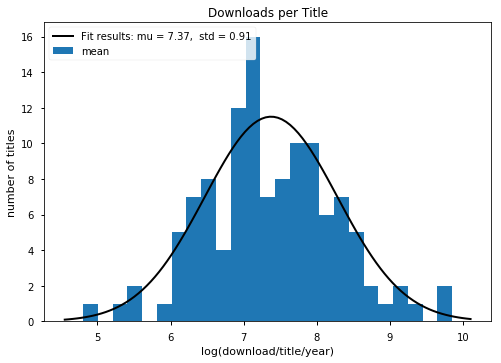
  1. Free ebook downloads are best measured on a logarithmic scale, like earthquakes and trade publishing sales.
  2. We shouldn't average download counts.

If you take the logarithm of book downloads, the histogram looks like a bell curve!
For example, if someone tries to tell you that "Engineering, mathematics and computer science OA books perform much better than the average number of downloads for OA books across all subject areas" without telling you about variances of the distributions and refusing to release their data, you should pay them no mind.

Next week, I'll have a post about why logarithmic scales makes sense for measuring open-access usage, and maybe another about how log-normal statistics could save civilization.

Thursday, December 27, 2018

Towards Impact-based OA Funding

Earlier this month, I was invited to a meeting sponsored by the Mellon Foundation about aggregating usage data for open-access (OA) ebooks, with a focus on scholarly monographs. The "problem" is that open licenses permit these ebooks to be liberated from hosting platforms and obtained in a variety of ways. A scholar might find the ebook via a search engine, on social media or on the publisher's web site; or perhaps in an index like Directory of Open Access Books (DOAB), or in an aggregator service like JSTOR. The ebook file might be hosted by the publisher, by OAPEN, on Internet Archive, Dropbox, Github, or Unglue.it. Libraries might host files on institutional repositories, or scholars might distribute them by email or via ResearchGate or discipline oriented sites such as Humanities Commons.

I haven't come to the "problem" yet. Open access publishers need ways to measure their impact. Since the whole point of removing toll-access barriers is to increase access to information, open access publishers look to their usage logs for validation of their efforts and mission. Unit sales and profits do not align very well with the goals of open-access publishing, but in the absence of sales revenue, download statistics and other measures of impact can be used to advocate for funding from institutions, from donors, and from libraries. Without evidence of impact, financial support for open access would be based more on faith than on data. (Not that there's anything inherently wrong with that.)

What is to be done? The "monograph usage" meeting was structured around a "provocation": that somehow a non-profit "Data Trust" would be formed to collect data from all the providers of open-access monographs, then channel it back to publishers and other stakeholders in privacy-preserving, value-affirming reports. There was broad support for this concept among the participants, but significant disagreements about the details of how a "Data Trust" might work, be governed, and be sustained.

Why would anyone trust a "Data Trust"? Who, exactly, would be paying to sustain a "Data Trust"? What is the product that the "Data Trust" will be providing to the folks paying to sustain it? Would a standardized usage data protocol stifle innovation in ebook distribution? We had so many questions, and there were so few answers.

I had trouble sleeping after the first day of the meeting. At 4 AM, my long-dormant physics brain, forged in countless all-nighters of problem sets in college, took over. It proposed a gendanken experiment:
What if there was open-access monograph usage data that everyone really trusted? How might it be used?
The answer is given away in the title of this post, but let's step back for a moment to provide some context.

For a long time, scholarly publishing was mostly funded by libraries that built great literature collections on behalf of their users - mostly scholars. This system incentivized the production of expensive must-have journals that expanded and multiplied so as to eat up all available funding from libraries. Monographs were economically squeezed in this process. Monographs, and the academic presses that published them, survived by becoming expensive, drastically reducing access for scholars.

With the advent of electronic publishing, it became feasible to flip the scholarly publishing model. Instead of charging libraries for access, access could be free for everyone, while authors paid a flat publication fee per article or monograph. In the journal world, the emergence of this system has erased access barriers. The publication fee system hasn't worked so well for monographs, however. The publication charge (much larger than an article charge) is often out of reach for many scholars, shutting them out of the open-access publishing process.

What if there was a funding channel for monographs that allocated support based on a measurement of impact, such as might be generated from data aggregated by a trusted "Data Trust"? (I'll call it the "OA Impact Trust", because I'd like to imagine that "impact" rather than a usage proxy such as "downloads" is what we care about.)

Here's how it might work:

  1. Libraries and institutions register with the OA Impact Trust, providing it with a way to identify usage and impact relevant to the library or institutions.
  2. Aggregators and publishers deposit monograph metadata and usage/impact streams with the Trust.
  3. The Trust provides COUNTER reports (suitably adapted) for relevant OA monograph usage/impact to libraries and institutions. This allows them to compare OA and non-OA ebook usage side-by-side.
  4. Libraries and institutions allocate some funding to OA monographs.
  5. The Trust passes funding to monograph publishers and participating distributors.

The incentives built into such a system promote distribution and access. Publishers are encouraged to publish monographs that actually get used. Authors are encouraged to write in ways that promote reading and scholarship. Publishers are also encouraged to include their backlists in the system, and not just the dead ones, but the ones that scholars continue to use. Measured impact for OA publication rises, and libraries observe that more and more, their dollars are channeled to the material that their communities need.

Of course there are all sorts of problems with this gedanken OA funding scheme. If COUNTER statistics generate revenue, they will need to be secured against the inevitable gaming of the system and fraud. The system will have to make judgements about what sort of usage is valuable, and how to weigh the value of a work that goes viral against the value of a work used intensely by a very small community. Boundaries will need to be drawn. The machinery driving such a system will not be free, but it can be governed by the community of funders.

Do you think such a system can work? Do you thing such a system would be fair, or at least fairer than other systems? Would it be Good, or would it be Evil?

Notes:
  1. Details have been swept under a rug the size of Afghanistan. But this rug won't fly anywhere unless there's willingness to pay for a rug.
  2. The white paper draft which was the "provocation" for the meeting is posted here.
  3. I've been thinking about this for a while.

Sunday, July 26, 2015

Library Privacy and the Freedom Not To Read

One of the most difficult privacy conundrums facing libraries today is how to deal with the data that their patrons generate in the course of using digital services. Commercial information services typically track usage in detail, keep the data indefinitely, and regard the data as a valuable asset. Data is used to make many improvements, often to personalize the service to best meet the needs of the user. User data can also be monetized; as I've written here before, many companies make money by providing web services in exchange for the opportunity to track users and help advertisers target them.

A Maginot Line fortification. Photo from the US Army.
The downside to data collection is its impact on user privacy, something that libraries have a history of defending, even at the risk of imprisonment. Since the Patriot Act, many librarians have believed that the best way to defend user privacy against legally sanctioned intrusion is to avoid collecting any sensitive data. But as libraries move onto the web, that defense seems more and more like a Maginot Line, impregnable, but easy to get around. (I've written about an effort to shore up some weak points in library privacy defenses.)

At the same time, "big data" has clouded the picture of what constitutes sensitive data. The correlation of digital library use with web activity outside the library can impact privacy in ways that never would occur in a physical library. For example, I've found that many libraries unknowingly use Amazon cover images to enrich their online catalogs, so that even a user who is completely anonymous to the library ends up letting Amazon know what books they're searching for.

Recently, I've been serving on the Steering Committee of an initiative of NISO to try to establish a set of principles that libraries, providers of services to libraries, and publishers can use to support privacy patron privacy. We held an in-person meeting in San Francisco at the end of July. There was solid support from libraries, publishers and service companies for improving reader privacy, but some issues were harder than others. The issues around data collection and use attracted the widest divergence in opinion.

One approach that was discussed centered on classifying different types of data depending on the extent to which they impact user privacy. This also the approach taken by most laws governing privacy of library records. They mostly apply only to "Personally Identifiable Information" (PII), which usually would mean a person's name, address, phone number, etc., but sometimes is defined to include the user's IP address. While it's important to protect this type of information, in practice this usually means that less personal information lacks any protection at all.

I find that the data classification approach is another Maginot privacy line. It encourages the assumption that collection of demographics data – age, gender, race, religion, education, profession, even sexual orientation – is fair game for libraries and participants in the library ecosystem. I raised some eyebrows when I suggested that demographic groups might deserve a level of privacy protection in libraries, just as individuals do.

OCLC's Andrew Pace gave an example that brought this home for us all. When he worked as a librarian at NC State, he tracked usage of the books and other materials in the collection. Every library needs to do this for many purposes. He noticed that materials placed on reserve for certain classes received little or no usage, and he thought that faculty shouldn't be putting so many things on reserve, effectively preventing students not taking the class from using these materials. And so he started providing usage reports to the faculty.

In retrospect, Andrew pointed out that, without thinking much about it, he might have violated the privacy of students by informing their teachers that that they weren't reading the assigned materials. After all, if a library wants to protect a user's right to read, they also have to protect the right not to read. Nobody's personally identifiable information had been exposed, but the combination of library data – a list of books that hadn't circulated – with some non-library data – the list of students enrolled in a class and the list of assigned reading – had intersected in a way that exposed individual reading behavior.

What this example illustrates is that libraries MUST collect at least SOME data that impinges on reader privacy. If reader privacy is to be protected, a "privacy impact assessment" must be made on almost all uses of that data.  In today's environment, users expect that their data signals will be listened to and their expressed needs will be accommodated. Given these expectations, building privacy in libraries is going to require a lot of work and a lot of thought.

Thursday, October 2, 2014

The Perfect Bookstore Loses to Amazon

My book industry friends are always going on and on about "the book discovery problem". Last month, a bunch of us, convened by Chris Kubica, sat in a room in Manhattan's Meatpacking district and plotted out how to make the perfect online bookstore. "The discovery problem" occupied a big part of the discussion. Last year, Perseus Books gathered a smattering of New York's nerdiest at "the first Publishing Hackathon". The theme of the event, the "killer problem": "book discovery". Not to be outdone, HarperCollins sponsored a "BookSmash Challenge" to find "new ways of reading and discovering books".  

Here's the typical framing of "the book discovery problem". "When I go to a bookstore, I frequently leave with all sort of books I never meant to get. I see a book on the table, pick it up and start reading, and I end up buying it. But that sort of serendipitous discovery doesn't happen at Amazon. How do we recreate that experience?" Or "There are so many books published, how do we match readers to the books they'd like best?"

This "problem" has always seemed a bit bogus to me. First of all, when I'm on the internet, I'm constantly running across interesting sounding books. There are usually links pointing me at Amazon, and occasionally I'll buy the book.

As a consumer, I don't find I have a problem with book discovery. I'm not compulsive about finding new books; I'm compulsive about finishing the book I've read half of. When I finish a book, it's usually two in the morning and I really want to get to sleep. I have big stacks both real and virtual of books on my to-read list.

Finally, the "discovery problem" is a tractable one from a tech point of view. Throw a lot of data and some machine learning at the problem and a good-enough solution should emerge. (I should note here that  book "discovery" on the website I run, unglue.it, is terrible at the moment, but pretty soon it will be much better.)

So why on earth does Amazon, which throws huge amounts of money into capital investment, do such a middling job of book discovery?

Recently the obvious answer hit me in the face, as such answers are wont to do. The answer is that mediocre discovery creates a powerful business advantage for Amazon!

Consider the two most important discovery tools used on the Amazon website:
  1. People who bought X also bought y.
  2. Top seller lists.
Both of these methods have the property that the way to make these work for your book is for your book to sell a lot on Amazon. That means that any author or publisher that wants to sell a lot of books on Amazon will try to steer as many fans as possible to Amazon. More sales means more recommendations, which means more sales, and so on. Amazon is such a dominant bookseller that a bookstore could have the dreamiest features and pay the publisher a larger share of the retail selling price and still have the publisher try to push people to Amazon.

What happens in this sort of positive feedback system is pretty obvious to an electrical engineer like me, but Wikipedia's example of a cattle stampede makes a better picture.

The number of cattle running is proportional to the overall level of panic, which is proportional to...the number of cattle running! "Stampede loop" by Trevithj. CC BY-SA
Result: Stampede! Yeah, OK, these are sheep. But you get the point. "Herdwick Stampede" by Andy Docker. CC BY.
Imagine what would happen if Amazon shifted from sales-based recommendations to some sort of magic that matched a customer with the perfect book. Then instead of focusing effort on steering readers to Amazon, authors and publishers would concentrate on creating the perfect book. The rich would stop getting richer, and instead, reward would find the deserving.

Ain't never gonna happen. Stampedes sell more books.

Monday, August 12, 2013

A Rational Framework for Library eBook Licensing

Since the Redigi decision made it clear that there is no right of first sale for digital content in the US, it's been much easier to think up realistic doomsday scenarios for public libraries in the US. Why should a publisher let a public library lend an ebook if Amazon or some other competitor were to offer much better terms? How would our public library system, saddled with difficult-to-use systems and unfavorable contracts, ever hope to compete?

Back when HarperCollins first announced that it would only let libraries lend their ebooks 26 times before they would expire, there was widespread outrage from the library community. Looking back on that, it seems pretty clear that a lack of consultation and poor customer communication fueled the furor. By itself, the lending limit could have terrible long-term consequences for libraries, but as part of a wider, well-thought out framework, it could be useful component.

I've been doing a lot of thinking about this over the last 3 years, and I've decided it's time to float a comprehensive proposal for how libraries and publishers might work together on ebook distribution to benefit the entire reading ecosystem. eBook lending as implemented to date has been founded on a combination of irrational fears and outmoded processes. We deserve better.

Behind this framework is a set of assumptions.
  1. Library ebook distribution must sustain and increase the total population of readers; this is a prerequisite for a healthy book publishing industry.
  2. Patron discovery of ebooks in libraries must connect effectively to ebook sales.
  3. Library distribution must become much more efficient, and overhead must become much smaller for ebooks than it is today for print books and ebooks.
  4. Long term preservation of ebook availability must be a joint undertaking of libraries and publishers.
  5. The economic models used for library ebook distribution must provide incentives for libraries and publishers to promote points 1-4.
I don't pretend that people won't disagree with some or all of these 5 assumptions, but if any of them are false, then, I think there will be NO distribution of ebooks through libraries. I also recognize that not all books are alike; even if library distribution works for some ebooks, it's unlikely that it will work for every ebook.

So the fifth assumption is what this post is really about. Given 1-4, what should an economic framework look like? Here are the features of a model that makes sense to me:
  1. Decoupled pricing. An ebook license that allows for lending makes the ebook more valuable, so why shouldn't it cost more than an individual, non-transferable license? I can't say whether Random House's 300% markup for libraries is excessive, but why not let the marketplace decide? For new, super-popular ebooks, maybe 500% markup makes sense. On the other hand, maybe ebooks that need exposure should have an 80% markdown because libraries might turn them into bestsellers.
  2. Rate limits instead of DRM. Patron license embedding.  I've written about this before. This may take the most convincing, but in thinking about the imperatives of effective discovery, low distribution overhead, and long-term preservation, I've concluded that there are no alternatives to major change in library distribution technology.
  3. Circulation charges after an initial period. Most books are bought in the first year of publication. Today, libraries "deaccession" books to match their declining demand. But there's no reason for a library to deaccession an ebook, so for most books the global supply for any given ebook will eventually exceed global demand. If the library can cut its transaction cost from ~$2 per circulation to $0.20 per circulation it seems fair to reward the publisher with part of the difference for developing books with long term value. 
  4. License transferability/InterLibrary Loan. Libraries rely on interlibrary loan to expand the scope of their collections and meet special needs. But ebook loans can be instantaneous, so digital ILL can compete directly with backlist sales. If the transaction costs (currently ~$10) for ILL can be squeezed down to $1 or so, there's plenty of margin to provide a transaction payment to the rights holder for the privilege of doing so. 
  5. Patron-funded purchases. Libraries are tight on funding even as they need to completely transform what they do. Their biggest asset is a huge reservoir of public goodwill. At this pivotal juncture, their ebook offerings are characterized by long hold queues. Why can't a library patron buy an extra copy for the library and jump to the front of the queue? Why don't publishers offer "Buy for your Library" buttons on their catalog pages? The reasons are complex, but it's mostly a case of "we haven't done that before". But if it doesn't happen I just can't fathom how library discovery can effectively plug into publisher commerce.
  6. License durability. If libraries are expected to "buy" ebooks, it should be pretty much for keeps. If the publisher for some reason has to revoke a license without cause, the library should get a refund of the license price.
  7. Archival copies. Libraries need to do a lot of things with books other than lending. Indexing and archiving are good examples. The saddest thing about the most successful library ebook distributors today is that libraries don't get access to unencrypted ebook files. If libraries are to offer effective discovery and archiving of ebooks, they need access to the files. Seems a no-brainer to me.
There are a bunch of parameters to plug into this framework; here's my guess as to what they should be:
  • Rate limits: One authenticated user per two weeks.
  • Circulation fee: $0 for the first year, after the first year, 2% of purchase price or $1 whichever is greater. 
  • ILL fee (publisher share): 5% of purchase price or $2, whichever is greater. 

A rational ebook lending framework would mean big changes for both the book publishing industry and the library industry. Even if a HarperCollins decided today that this was an attractive way forward, it would be hard-pressed to find a way to implement it, because libraries just don't work that way. So it seems a bit far-fetched at this point. Based on the iBookstore fiasco, it appears to be illegal for big publishers to even talk to each other, let alone drive business model changes. It's good that a library group is still trying to figure it out.

Maybe some small startup company could try some sort of pilot program.

Saturday, August 3, 2013

Wattpad Usage is in the Ballpark of US Public Libraries

Billion Reasons Why, a novel
by xXdemolitionloverXx
on Wattpad
While working on another article, I came across this bit of data. Wattpad, the reading and writing community that's sort of a YouTube for stories, claims that its users are spending 3.5 billion minutes per month on the site. That's a number so big that I had no context for it.

So I wondered, how many minutes per month do people spend in their public libraries? There's a lot of data available for US public libraries from IMLS. In 2010, the most recent year for which data is available, 1.57 billion visits were made to US public libraries, or about 131 million visits per month. I have no idea how long an average library visit lasts, but let's say it's a half hour, then the total minutes of "user engagement" by US public libraries would be about 3.9 billion minutes per month. Roughly the same as Wattpad.

Maybe we should also count the time that readers spend at home with a library book, 30 minutes might be a serious underestimate. (see update) Also, Wattpad's usage is spread out internationally- they are the top mobile site in the Phillipines, for example. So its usage within the US is probably quite a bit less than public libraries. But it's also concentrated in certain demographics- teenage girls, for example. And it continues to grow at a solid pace.

Update: Karen Coyle point out in comments that you could also estimate library user engagement by looking at circulations. By that measure, assuming an average of 4 hours of reading per book, you get that US public libraries are about 8 Wattpads of engagement.

Any way you look at it, that's a lot of reading going on.

Tuesday, May 14, 2013

Hack the Publishing Hackathon

Why a publishing hackathon?
Book discovery needs innovation. It’s never been easier to get a book into a reader’s hands—just one click. But, with over 10,000 books published each year on every topic imaginable, how do people find out about them? There are fewer bookstores to help readers discover exciting new authors and ideas. There’s currently no digital experience that replicates the serendipity of browsing bookshelves. Recommendation engines are fairly primitive – they know what you bought, but they don’t know why. It’s a disruptive opportunity that hasn’t been explored.
Seriously, the sponsors of this event don't think book discovery has been explored? I guess they were too busy suing Mr. Google to notice that Google Books is a pretty good discovery tool. I suppose they never thought to ask Mr. Wikipedia how many books are published every year.

All in all, I find the description of this hackathon INSULTING to just about every developer that's worked in the general vicinity of the book industry.

Umm. Mr. Steinberger. If you and Perseus really want to promote discovery innovation, then perhaps you have heard of Goodreads? They're driving some decent discovery of books. Maybe it doesn't count if Mr. Amazon is buying them. Perhaps you've heard of Amazon? They popularized the "If you liked this, maybe you'll like..." feature that everyone in the publishing industry tries to copy. If you don't like Goodreads, maybe I can introduce you to LibraryThing, which has been driving valuable book discovery in more ways than I can list here. I know that "library" in their name is a big turnoff for your big 6 colleagues, but libraries are huge book discovery machines. I don't suppose you want them to disrupt anything. And umm DP.LA????

People mostly discover books by word of mouth. Some  innovators promoting social reading include Readmill (who had their own publishing hackathon) and (giving props to the NYC home team) ReadSocial and the stuff Bob Stein has been exploring. And Kobo, Copia and Zola are doing some amazing things to integrate book discovery with ebook selling and reading environments. I've written previously about Jellybooks' fresh approach to discovery.

And some more on libraries. When I was at OCLC, we worked on real simple problems like "how do you discover the other editions of the same book?" and we found that publishers had NO CLUE what they'd published 5 years previous. So yeah, we did our bit.

But I'm coming to the hackathon anyway. because despite the ridiculous framing, this event has some clueful backers. NYPL for one. Small Demons for two. And they're even wasting prize money on a new age library metadata thingy. (I might be wrong about the wasting part.)

I'm hoping that some people will be interested in rethinking ebook front matter. Unglue.it needs books to work better all by themselves. The best discovery instrument for a book is the GDMF book, to my mind. So let the book do some work. With a little javascript. And no more DRM, thank you very much!
Enhanced by Zemanta

Friday, December 16, 2011

How to Dig for Book Data Treasure


To me, surest indicator of an impending doom for book publishing is hearing a publisher cite the advertising of Attributor, an anti-piracy solutions company, as if it were science. It's not the attitude towards piracy that bothers me, that's entirely sensible. It's the implied devaluation of honest data that depresses me.

There's hope though. I've gotten to know quite a number of people throughout the reading ecosystem with whom I can use the word "data" as high praise, roughly equivalent to the word "gold". If you're reading this, chances are you're a member of this secret society, and what follows is a sketch of a treasure map.

In a recent post, I promised to suggest ways that we might measure the effects of library ebook lending on book sales. If you think about it, there are many parallels between attempting such a measurement and previous studies that have tried to measure the effect of ebook piracy on book sales. Unfortunately, the only objective study I know of was a small study done by Brian O'Leary, and the effects observed in that study were small and in a direction counter to popular narratives (and thus rarely noted in the sort of presentations that cite Attributor advertising).

In that study, O'Leary looked for time-domain correlations between sales figures for books from two publishers and the appearance of the same books on BitTorrent. A similar study focused on library Lending could be much more compelling, because library circulation data is a much more direct measure of distribution than any sort of torrent tracking, and librarians are much better than pirates at sharing data.

With the cooperation of booksellers, library circulation and holdings could be compared and correlated to store-by-store sales. For example, you could look at a book that's held in a significant fraction of libraries and look for correlations (positive AND negative) between areas where a library is circulating the book and stores where the book is selling. You've have to remove regional and demographic variance, of course, but with enough data, almost anything is possible.

With the cooperation of a large publisher, rigorous experiments could be done. Scientific experiments derive rigor from the use of controls. To prove that lending influences sales, it's not enough to do lending and look for sales. A rigorous experiment would have both a trial where books are lent and an identical trial where the same books are not lent.

One way to control a lending experiment would be to make a random selection of a publisher's catalog available for lending. Imagine if Penguin had worked with the library community on an experimental withholding of a random part of its catalog from Overdrive. The sales could be analyzed for patterns and trends.

It's important that data analysis of this sort be done objectively by researchers with integrity. In any large collection of data, it's possible to focus on data which supports one narrative over another. If lending-sales studies were done, my guess is that some types of books would show correlations very different from others.

I've used the word "cooperation" several times already. I'm not so naïve as to think that data sharing will materialize out of thin air. Perhaps the sort of eco-system wide organization envisaged by the same Brian O'Leary could be the vehicle to make data treasure digging possible. Opportunity in Abundance for the win!

Enhanced by Zemanta

Friday, December 9, 2011

Book Lending Ignorance


To what degree does library book lending complement book sales, and to what degree does library lending substitute for book sales? I don't think anyone knows for sure. (Well maybe Amazon, but they're not telling.)

With over 40 billion dollars per year of sales at stake, you would think that the US book publishing industry would want to know as much as possible about how those sales are generated. Since US public libraries circulate more items than US bookstores sell, the industry needs to understand the role of libraries in getting people to read and purchase books. Is it small or big? Does the existence of libraries promote sales or hurt sales? How do the equations change when books become digital?

Publishers do a pretty good job of compiling sales data, and they spend a lot of money to figure out what books are selling and who's buying them. According to BookStats, a cooperative study by the AAP and BISG, Americans bought an average of 7.32 books in 2010.

On the library side, there's a bunch of interesting data. IMLS has been compiling a wealth of data about the footprint of public libraries, which is why I can tell you that the average American borrowed 8.1 items from public libraries in 2009. Library Journal has recently published the first installment of results from a fascinating survey of library patrons. (Aside: this study should be made available in every library!) They find that 46% of respondents use the public library less than 2 times per year.

The LJ Patron Profiles survey shows a strong relationship between library use and book purchasing. For example, over half of survey respondents report buying a book by an author whose works they'd previously borrowed from the library. That's a huge number, considering that 20% of respondent never go to the library, period. At the same time the survey indicates a competition between reading and borrowing. Respondents who report that they've decreased their use of libraries buy 12.18 books per year, while those who've increased their library usage buy only 10.9 books per year. What we can't tell from the data is cause and effect. With the recession having a wide impact, who's to know whether the folks showing up more at libraries might buy even fewer books if the libraries weren't around!

It costs about 11 billion dollars a year to run public libraries in the US, and libraries work hard to demonstrate their value to the communities that support them. They compile data to measure their activity and the community's return on their investment in libraries. These studies assign much of the benefit of library spending to substitutional activity. For example, a survey by Denver Public Library determined in 2009 that it saved its community $105 million based on the cost to use alternative sources of information, and delivered an additional $5 million by avoiding "lost use", activity that wouldn't have occurred if the library did not exist. (See Public Libraries- A Wise Investment (PDF, 1.4 MB) from Library Research Service)

Do libraries really believe that 91% of their circulations would have resulted in purchases if they didn't exist? There's no hard evidence anywhere that that's true. Every librarian can tell you about patrons who loved a book so much they went and bought the whole series, but there are also users who never buy a book they can get in the library. And what about those readers who never go to the library? Surveys are a cheap way to collect data, but they often don't reflect the real behavior of the people surveyed.

So much is unknown, and so much is to be gained by knowing more. What hasn't been done, as far as I know, is to try to compare and correlate hard data on book sales and library lending in any meaningful way. In my next post, I'll describe how a cross-industry cooperative approach to book data collection and analysis might provide some light amid the gloom of the reading industry's winter solstice of understanding.

Monday, March 28, 2011

Statistician Can't Distinguish Library Patrons from Monkeys

If you're a librarian nodding at the title, no, that's not what I mean.

The statistician in question is Carnegie-Mellon Statistics Professor Cosma Shalizi. He's made a habit of debunking claims by physicists, economists, and computer scientists that their data shows power-law behavior in this-or-that system. When I say he can't distinguish library patrons from monkeys, I don't mean that Prof. Shalizi is near-sighted or that he's unfamiliar with the grooming habits of library patrons. I mean that Shalizi is arguing that the distribution of book circulation that I wrote about two weeks ago can be explained by completely random processes.

In his comment on my blog post, Shalizi reanalyzed the circulation data from University of Huddersfield and shows that it can be fit well by a "log-normal" distribution, and that the very high-usage tail of the Huddersfield data is not consistent with a power law (such as the one I gave in my post). I've confirmed  his analysis, which went much farther into the high-usage tail than my first pass. This is done by looking at the cumulative distribution, i.e. plotting the number of books that have circulated less than a certain number of times.

If you want to make the connection to the monkeys in the library, it's important to understand the generating mechanisms that lead to log-normal distributions. These often arise from random growth processes, and are just like the standard "bell-curve", but on a log scale.

Here's how a random growth process could apply to book use. Let's suppose that every day, everyone who has read a book flips a coin. If heads, they do nothing. If tails they try to get someone else to also read the book. The group of people that has read the book thus grows by some percentage. Repeating this process over and over causes the book's usage to grow randomly. If we then measure the  size of these groups, the readership sizes will follow a log-normal distribution.

There's a saying among experimental physicists. "Keep taking data until you have enough to write an article for Physical Review Letters. Then stop taking data." In my previous post on book use, I violated this rule by asking other libraries to share their circulation data for analysis. Ross Riker at Goshen Public Library in Indiana stepped up to the challenge.

Goshen has accumulated circulation data since their automation system was installed in 1996. Riker sent me the number of times each of 144,269 items currently held had been circulated, for a total of 3.04 million circulation events. I've plotted the data on the graph below, alongside the Huddersfield data. It looks somewhat different, doesn't it? I sent the Goshen data to Shalizi, and his analysis was that neither log-normal or power-law distributions could fit the data.

Is book use in an American public library governed by different principles from that in a British academic library? Probably not. I noticed that the maximum number of circulations at Goshen was 251. The standard circulation period at Goshen is 3 weeks, so there's one book that's been checked out for 14.44 years solid, or since late 1996, which is about when Goshen began collecting data.

If we want to look at book use, what we should be plotting is the the rate at which the book is being circulated. That's equal to the number of circulations divided by the time the book is actually on the shelf.

After applying time-on-shelf corrections, the data from both Goshen and Huddersfield are well fit by log-normal distributions. To compare the Huddersfield data to the Goshen data, we need to take into consideration another difference. The Goshen data is listed item by item, so if there were two copies of a book, they count as two items. The Huddersfield data groups the circulation counts for all copies of the same book. To properly compute the time-on-shelf factor, I adjusted the circulation rate based on the number of copies held for each book.

After applying the appropriate corrections, the resulting distributions (below) are amazingly similar for the two libraries, and fit beautifully to log-normal distributions. Both distributions even have a bulge at the very highest circulation rates. At Huddersfield, inspection of the relevant bulge items suggests that they're texts used in particular courses, and have circulation times shorter than the main collection.

You may be disappointed to learn that the distribution of book use can be explained by random processes without reference to metadata quality, selection efficiency, or discovery system details. Nor does it derive from a power law characterizing the structure of user networks or citation graphs. All of the circulation distribution data I've looked at is consistent with there being one driving force in the distribution of book use. The non-technical term for this driving force: word of mouth.

Maybe I should stop taking data.


Notes:
  1. The formula for a log-normal distribution is:
    where μ and σ are the mean and variance of the logarithm of the distribution. If you use Excel, the lognormal distribution is built-in:   LOGNORMAL(f,μ,σ,FALSE). (TRUE gives the cumulative distribution function)
  2. It's not surprising that you get a better fit with a log-normal distribution than with a power-law. The log-normal distribution gives you an extra fitting parameter, after all. But when you include the full high usage tail, the power law predicts a lot more extremely high usage books than is observed.
  3. The time-on-shelf correction has a bit of fudge-factor in it. If the standard circulation period is 3 weeks, that doesn't mean that every user keeps it for three weeks, or that the book gets reshelved immediately after 21 days. My fit uses an average time-off-shelf period of 18 days.
  4. My log-normal fit for Goshen has a mean of 2.95 and a sigma of 0.94. For Huddersfield, I get a mean of 2.22 and a sigma of 0.77 after conversion to item data. The larger mean gives the higher circulation per item at Goshen. Feel free to speculate about the sigmas.
  5. The titles with the highest per-copy circulation rates at Huddersfield are:
    • Music in medieval Europe
    • An introduction to business ethics
    • A guide to the harpsichord
    • On humour : its nature and its place in modern society
    • Japan
    • The BBC and public service broadcasting
    • Authenticity in performance : eighteenth-century case studies
    • Mozart's Requiem : on preparing a new edition.
    • Asia's next giant : South Korea and late industrialization
    • Handel's operas : 1704-1726
    • Cognitive psychology : a student's handbook
  6. Raw data sets are available for Huddersfield and Goshen.
  7. For a readable discussion of generating mechanisms for power laws and log-normal distribution, I recommend "A Brief History of Generative Models for Power Law and Lognormal Distributions" by Michael Mitzenmacher, Internet Mathematics Vol. 1, No. 2: 226-251. [PDF 382KB].
  8. My comments re Harper-Collins are unaffected by this re-analysis, but my quantitative modeling of the budget impact of the new ebook policy will change a bit.
  9. Monkeys aren't really random, but I bet if one started reading a book, there would soon be a crowd of monkeys wanting to read the same book!

Tuesday, March 15, 2011

Help Me Study the Physics of Book Use

I am not a librarian. I'm not a bookseller. I'll admit to some librarian tendencies- when I was little, I liked to line up my trucks and sort them from biggest to smallest. But my education and training was in engineering and physics. My approach to the analysis of data is that of a scientist. So when I analyzed the distribution of circulation across the collection of University of Huddersfield, I treated the data as a window into the physics of book use.

"Physics???" you may be thinking to yourself. Yes, physics. Well, maybe it would be economics if I had gotten past Econ 101 in college. But I feel comfortable with physics- I have 76 published articles to fall back on. Physics tries to describe things that happen in terms of simpler phenomena. It aims to connect observables (thing you can measure) to their root causes, and then uses that understanding to predict other observables. It doesn't matter so much whether the basic event is one particle hitting another, or one patron checking out a book, if broad patterns can be observed in these events, then a physicist can measure the patterns and try to deduce the causes.

That's why I was so excited to observe a power-law dependence in book-circulation frequency when I analyzed the data made available by the University of Huddersfield. In 15 years of research into crystal growth and electronic properties of semiconductors and superconductors, I never worked with such a well-behaved set of measurements. And as a physicist, I'm trained to believe that when a measured quantity obeys a mathematical relationship, then there must be a reason for it, even if I don't understand that reason yet.

Right now, I don't know why the book circulation in the Huddersfield library obeys a power law. A physicist would call this power law "phenomenology". Without an understanding of how it arises, I can't say whether it should apply to other libraries. I can't say if it would apply to ebook sales at Amazon, or holdings in Worldcat. It might be an accident. But it would be really cool if it was real, because at the core, it must be connected to how people choose things to read.

What causes people to buy a particular book, or borrow a particular book from a library? You would think that many people might want to know. Publishers and librarians might answer that books are read because they're good. But is there any concrete evidence that book quality has anything to do with sales or circulation? Ask any author if sales are correlated to quality, and they'll tell you about a wonderful book that nobody has bought or read. So maybe other factors  are more important.

A lot of recent discussion has revolved around the unproven hypothesis that library circulation leads to increased sales. The evidence cited, though compelling, is anecdotal and non-quantitative:
Eat, Pray, Love: One Woman's Search for Everything Across Italy, India and IndonesiaPenguin’s runaway hit, Eat, Pray, Love (Viking), was published in February 2006 with an initial run of 30,000 hardcover copies. The title didn’t become a bestseller until March 2007. In the meantime, copies of Eat, Pray, Love changed hands thousands of times through book clubs and libraries, scoring rave reviews from Library Journal and stirring up chatter among leading library blogs such as Memphis Public Library and San Mateo Public Library. Thanks to word-of-mouth marketing and library lending, when the paperback hit newsstands, Eat, Pray, Love sales skyrocketed.

It would be useful to really know how important this factor is.

I'm guessing that the power law I observed has very little to do with distributions of book quality and much more to do with how people are distributed and connected to each other- for example, city sizes are well described by a power law. I think that people pick books to read based mostly on what other people have read. That's what creates a best-seller. By studying the distribution of book usage, we may be able to prove that this is so.

So here's where I need help. We need to have more data sets to look at. If the power-law behavior is universal, it should show up in a wide variety of circulation statistics.

There are also situations where the power-law won't apply. It may seem odd to say this, since we don't understand where the power law comes from in the first place, but there are things it CAN'T do. For example, in the comments on the last post, "miker" reported some circulation numbers from a consortium. He blindly plugged in his numbers to my formulae, and got predicted numbers within a factor of two of the observed numbers, which seemed pretty miraculous to me. He was disappointed. 

Miker's data covers 4 years compared to Huddersfield's 13, and so a book that has circulated 100 times probably has spent little time on a library's shelves. A power law predicts significant numbers of books even at impossibly high usage. For example, the power-law fit to miker's data predicts that over a thousand books would be circulated more than once a day, which isn't possible given normal lending periods. See the notes if you're not scared of math and want to know how to adjust a fit.

The best way to advance the study of this phenomenon is to look at more data. If you have access to library circulation data, you can extract some numbers and publish them. A comment here would be appreciated. It's most helpful to report the number of items that have circulated f times as a function of f. Tab delineated text works great. In addition, analysts need to know the total number of items, total number of circulations, and the number of years covered by the data. An indication of the typical lending period would also be nice.

Along with a better understanding of how book collections get used, a better science of book use will help libraries and publishers formulate ebook circulation models that make sense for everybody who benefits from the reading of books. That's all of us.

Notes:
  1. If you want to fit a power law to circulation data truncated at some lending frequency fmax, you have to adjust the fitting parameters. We still have the same expression for the number of circulations for a given frequency, N(f).
    But the computation of the parameters from collection size and total circulations is more complicated:
    It's easiest to solve these equations numerically for N0 and A from the known C, N and fmax
  2. Please read the follow-up.
Enhanced by Zemanta

Friday, March 11, 2011

The Pareto Principle and the True Cunning of HarperCollins

I take it back. I see now that HarperCollin's new strategy for ebooks in libraries is not nearly as senseless as it first seemed to me. In fact, it's a cunning plan worthy of Blackadder. In case you're new to this library and publishing controversy, HarperCollins, one of the "Big 6" US publishers, has decided to require the expiration of the ebooks it offers to libraries after 26 checkouts. A library would have to relicense the ebook after the 26 checkouts if it want to keep the ebook in its circulating collection. Needless to say, librarians and many others were not happy about this.

HarperCollins' strategy puzzled me, because I couldn't figure out how it would make any money for them. I thought any extra sales caused by ebook expirations would likely be offset by poor sales of the limited-durability ebooks.

Libraries struggled to figure out how the new policy would affect them, and started looking at their circulation statistics. For example, Laura Crossett reported that at her library, 23,083 out of the 88,680 circulating books in her library's collection had been checked out more than 26 times over the course of 15 years. 220 books had been checked out more than 100 times. Matt Hamilton reported his numbers: 7566 books from a collection of 288,793 had circulated more than 26 times; 942 items had circulated more than 52 times. Most of the materials in his library are 3-4 years old. On Twitter, West Chester Public Library reported over 10,000 books from its collection of 58,000 had been borrowed more than 26 times over 17 years. Jason Griffey reported stats from his (academic) library: in 10 years, only 126 items from a collection of 409,213 had circulated more than 26 times.

These numbers are a bit all over the map, and I wanted to make some sense of them. According to IMLS data for 2007, US public libraries had collections totaling a bit more than 812 million print volumes. They circulated these items 2.17 billion times in 2007. That works out to an average of 2.6 circs/volume. Of course circulations will be unevenly distributed, but if HarperCollins terms were applied to print, the "average" volume would be expected to last 10 years.

A true understanding of these numbers would come from a better characterization of how circulation is distributed over the collection of a real library. You've probably heard of the "80/20 Rule" which in this case would say that 80% of the borrowing is concentrated on 20% of the collection. This is also known as the "Pareto Principle" which is a consequence of power-law distributions. I wondered if this was a good description of book circulation in libraries. I wanted to see some data.

OCLC's Lorcan Dempsey pointed me to the motherlode. The University of Huddersfield, in England, has released a huge file containing circulation and recommendation data extracted from almost 3 million transactions spanning over 13 years. I set to work analyzing the data.

The result is quite remarkable. The data shows a distribution of circulation frequency following a power law over 3 orders of magnitude, with a R2 of 0.9969! (update: see note 10 below.) Here's the plot of the number of books that have been circulated N times at Huddersfield:

The equation for the circulation is pretty simple:

Here, N(f) is the number of books that have been checked out f times. N0 and A are fitting parameters; I used A=9 in my plot of the Huddersfield data. If I use the total number of circulations and the total size of the collection to fix these two parameters, I get a zero-parameter fit of the data that's still amazingly good, R2 of 0.9760

Using this equation, I can calculate what a limited check-out ebook "should" be worth, but I'll leave that to another post, seeing as even one equation may be too much for this blog post.

What I'll focus on here is the what's been referred to in the library literature as the "vital few" principal that results from this distribution. A large majority of the circulations are taken up by a relatively small fraction of the collection. In the Huddersfield data, roughly 20% of the collection is in fact responsible for roughly 80% of the circulation.

If we think about this in the context of ebook lending models, we see that HarperCollins has played a neat trick. By focusing our attention on the books that are lent many times, supposedly shortchanging the publisher and the author, HarperCollins has gotten us to overlook the 80% of books that don't circulate much at all. Libraries pay full price for those, too, and it's pretty clear that publishers make infinitely more money on books that don't circulate in libraries than on books that don't sell in bookstores!

On balance, the economic effect of libraries, in addition to those I've discussed before, is to shift money from very popular books to those that are less popular. It can be argued that libraries support a breadth of culture that would go away without their support. Guess who publishes those very popular books? The Big 6 publishers, of course. They pay the big advances to authors, the big coop advertising fees to bookstores, they get their authors on talk shows and their books reviewed in the Times. That takes a lot of money, but the expenditure is richly rewarded by a "vital few" or "smash hit" economy.

So here's the cunning. By focusing on popularity-driven revenue mechanisms, HarperCollins is pushing money towards the smash hits and away from the long tail. Libraries may be adversely affected, but they're collateral damage. It's the long tail publishers that HarperCollins is trying to destroy.

All of HarperCollins' strategy is directed  at making hits bigger. The loss of big-box bookstores like Borders has disproportionately hurt  smash-hit publishing houses. They're poorly positioned to take advantage of the internet-induced fattening of the long tail that has been documented by Brynjolfsson, Hu and Smith in their paper on Amazon sales rankings. Rather, Big 6 profitability is improved by selling more copies of fewer books.

I didn't think so, but the HarperCollins strategy really does make sense. It's part of the big push.

Notes:
  1. For a review of what people have written about HarperCollins, Librarian by Day is all over it.
  2. Thanks to Dave Pattern at Huddersfield and the JISC TILE Project for making the release of the circulation data possible.
  3. The Huddersfield data starts at books with 5 circulations. For counts greater than 100, I binned the data in groups of 10 to reduce noise. The data falls off the power law at over 400 circulations/book. This must be close to limit of always being in circulation.
  4. Yes, all you need is the total circulation and the collection size to predict the distribution of the circulation. If you want to model your own circ stats, the formulae for A and N0 are as follows:
    • A = C/2N where C is the total circ and N is the number of items in the collection.
    • N0 = (3/4) (C3/2N)1/2
    Amazing, isn't it? Remember this is an idealized system, so your mileage may vary. Weeding will pull down the small N part of the curve; availability limits will truncate the large N part of the curve.
  5. The "vital few" principle was articulated by JM Juran in 1954. "Universals in management planning and controlling" Manage. Rev. 43(11), 748–61 (1954).
  6. JD Eldridge has a nice discussion of Juran, Pareto, and Trueswell (another scholar of book circulation) in "The vital few meet the trivial many: unexpected use patterns in a monographs collection", Bull. Med. Libr. Assoc. 86(4), 496–503 (1998). http://www.ncbi.nlm.nih.gov/pmc/articles/PMC226441/
  7. Brynjolfsson, Erik, Hu, Yu Jeffrey and Smith, Michael D., "The Longer Tail: The Changing Shape of Amazon’s Sales Distribution Curve" (September 20, 2010). Available at SSRN: http://ssrn.com/abstract=1679991. I plotted the Huddersfield data as done in this paper, and the library curve has the same slope they report for the 2008 Amazon data. Not very straight, though.
  8. Brynjolfsson, Erik, Hu, Yu Jeffrey and Simester, Duncan, Goodbye Pareto Principle, "Hello Long Tail: The Effect of Search Costs on the Concentration of Product Sales" (November 2007). Available at SSRN: http://ssrn.com/abstract=953587. This is a study very relevant to libraries. I wish these guys would show more data, though.
  9. There's a lot of old work (60s and 70s) on library circulation distributions with a whole bunch of theory. It's impressive, because they seem to have collected data by hand, but I fear the theory is too old to be useful. The 80s and 90s were marked by huge advances in the scientific study of self-organizing systems resulting in power laws.
  10. (added March 17) Cosma Shalizi (first commenter on this post) has done a fit of the Huddersfield data to a Log-Normal distribution; I'll try to explain what this means in a subsequent post.