Showing posts with label authentication. Show all posts

Tuesday, December 3, 2019

Your Identity, Your Library

Today, your identity on the Internet is essentially owned by the big email providers and social networks. Google, Yahoo, Facebook, Twitter - chances are you use one of these services to conveniently log into other services as YOU. You don't need to remember a new password for each service, and the service providers don't have to verify your "identity". What you gain in convenience, you lose in privacy, and that's turned out really well, hasn't it?

The "flow" you use to take advantage of this single sign-in is a "dance" that takes you from website to website and back to the site you're logging into. A similar dance occurs to secure access to resources licensed on you behalf by libraries, institutions, corporations, etc.. I wrote a bunch of articles about "RA21" (now rebranded as the vaguely NSFW "SeamlessAccess"), an effort spearheaded by STM publishers to improve the user experience of that dance. (It can be complicated and confusing because there are lots of potential dance partners!)

Henri Matisse, La danse (first version) 1909

These dance partners style themselves as "identity providers". That label makes me uncomfortable. Identity can't be something that can be stripped from you by on the whim of a megacorporation. Instead, internet identity should be woven from a web of relationships. These can be formed digitally or face-to-face, global or local, business or personal.

You'd have thunk that the whole identity-on-the-internet thing would have improved in the 13 years since that login dance was first rolled out. And you'd be almost right, because a new architecture for internet identity is now on the horizon. Made possible by many of the same technologies that are securing the internet and inflating the blockchain bubble, massively distributed and even "self-sovereign identity" are becoming real-ish.

These technologies will inevitably be applied to the access authorization problem. Access via distributed identity replaces the website-to-website dance with the presentation of some sort of signed credential. A service provider verifies the signature against the signer's public key. It's like showing a passport that can't be forged. A tricky bit is that the credential also needs to be checked against a list of revoked credentials. This would have been cumbersome even ten years ago, but distributed databases are now a mature technology, versions of which underpin the internet itself.

Interlinked with the concept of distributed identity is the notion that users of the web should be able to securely control their data, and that decisions about what a web site gets to know about you should not be delegated to advertising networks.

Unfortunately, we're not quite ready for distributed identity, in the sense that implementation for today's web would require users to install plugin software, which has its own set of usability, privacy and security issues. The ideal situation would be for some sort of standardized distributed identity and secure data management capability to be installed in browser software - Chrome, Firefox, Safari, etc.

There's a lot of work going on to make this happen.
  • ID2020 has put out an identity manifesto that starts with the declaration that "The ability to prove one’s identity is a fundamental and universal human right."
  • Tim Berners-Lee is leading the Solid Project, which let's you "move freely between services, reuse data across apps, connect with anyone, and select what you share precisely".
  • The W3C Verifiable Claims Working Group has published Technical Recommendations for "Verifiable Credential Use Cases and a "Verifiable Credential Data Model". They observe that "from educational records to payment account access, the next generation of web applications will authorize entities to perform actions based on rich sets of credentials issued by trusted parties."
  • The Sovrin Network is a "new standard for digital identity – designed to bring the trust, personal control, and ease-of-use of analog IDs – like driver’s licenses and ID cards – to the Internet."
  • Kaliya Young, Doc Searls and Phil Windley have been convening the Internet Identity Workshop twice a year since 2005 to create a community centered around internet identity. A glance at prior year proceedings gives a flavor of how much is happening in the field
The common thread here is that users, not unaccountable third parties, should be able to manage their identity on the internet, while at the same time creating a global chain of trust.

It seems to me that there's a last-mile problem with all these schemes. If identity is really a universal human right, how do we create a chain of trust that can include every human? That problem becomes a lot easier to solve if there were some sort of organization with a physical presence in communities all over, trusted by the community and by other organizations. A sort of institution experienced in managing information access and privacy, and devoted to the needs of all sorts of users.

In other words, what if "libraries" existed?

The federated authentications systems used by libraries today - Shibboleth, Athens, and related systems use a dance similar to what you do with Google or Facebook. It's a big step that moves your internet identity away from "surveillance capitalists" towards community institutions. But you still don't have control over what data your institution give away, as you will in the next-generation internet identity systems I describe here. (RA21 is no different from Shib or Athens in this respect.)

What might libraries do to prepare for the age of distributed identity? The first step is not about technology, it's about mission. I believe libraries should start to think of themselves as internet relationship providers for their communities. When I get access to a resource though my library, I won't be "logging in",  I'll be asserting a relationship with a library community, and the library will be standing behind me. Joining an identity federation is a good next step for libraries. But the library community needs to advocate for user identity as a basic human right and prepare their systems to support a future where no dancing is required.

Update 12/5/2019: revised last two paragraphs to be less mystifying.


Monday, May 13, 2019

RA21 doesn't address the yet-another-WAYF problem. Radical inclusiveness would.

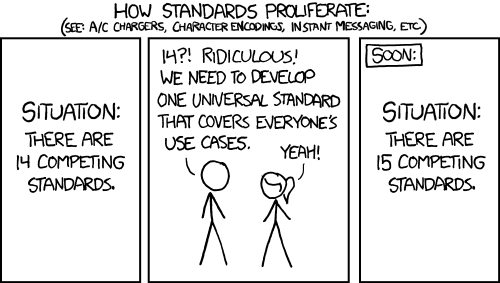
The fundamental problem with standards is captured by XKCD 927.
XKCD https://xkcd.com/927/
Single sign-on systems have the same problem. The only way for a single sign-on system to deliver a seamless user experience is to be backed by a federated identity system that encompasses all use cases. For RA-21 to be the single button that works for everyone, it must be radically inclusive. It must accommodate a wide variety of communities and use cases.

Unfortunately, the draft recommended practice betrays no self-awareness about this problem. Mostly, it assumes that there will be a single "access through your institution" button. While it is certainly true that end-users have more success when presented with a primary access method, it's not addressed how  RA-21 might reach that state.

Articulating a radical inclusiveness principle would put the goal of single-button access within reach. Radical inclusiveness means bringing IP-based authentication, anonymous access, and access for walk-ins into the RA-21 tent. Meanwhile the usability and adoption of of SAML-based systems would be improved; service providers who require "end-to-end traceability" could achieve this in the context of their customer agreements; it needn't be a requirement for the system as a whole.

Radical inclusiveness would also broaden the user base and thus financial support for the system as a whole. We can't expect a 100,000 student university library in China to have the same requirements or capabilities as a small hospital in New Jersey or a multinational pharmaceutical company in Switzerland, even though all three might need access to the same research article.


This is my fourth comment on the RA-21 draft "Recommended Practices for Improved Access toInstitutionally-Provided Information Resources". The official comment period ends Friday. This comment, 57 others, and the add-comment form can be read here. My comments so far are about secure communication channels, potential phishing attacks, and the incompatibility of the recommended technical approach with privacy-enhancing browser features. I'm posting the comments here so you can easily comment. I'll have one more comment, and then a general summary.

Update July 10, 2019:

RA21's official response to this comment is:
RA21 envisages supporting the anonymous and walk-in use cases via federated authentication. It is anticpated that federated authentication and IP authentication will exist side-by-side during a transition phase. The specifics of the User Experience during the transition phase will need to be determined during implementation; however it is likely that the RA21 button will simply not need to be displayed to users who are IP authenticated.
I suppose self-awareness was a big ask. The revised recommendation includes some "envisaging" of use cases that was glaring by omission in the draft recommendation. The added section 2.1.1., Employ appropriate authentication mechanisms for specific use cases, is an improvement on the draft; but the revised recommendation has not retreated from its end-to-end traceability "guiding principle".

RA21 used the same response for a comment by Ohio State's, Jennifer Vinopal:
I want to reiterate a point that a number of commenters have already mentioned: there is no discussion of how public or walk-in (or other unauthenticated/unauthenticating) users will get access to resources through RA21. Public libraries, as well as many college and research libraries, negotiate our e-resource licenses to provide access to walk-in users who aren?t represented in our IdM systems.
Don't forget, EZProxy was supposed to be a transition phase!


Sunday, May 5, 2019

RA21 RP does not require secure protocols. It should.

As I've written, "RA21" could be a Good Thing, or it could be a disaster. The RA21 working group has released its "Recommended Practice" draft for comments, until May 17. The draft has much to like, but also has significant flaws. I will be contributing comments to address the flaws I see, which I will also publish here so we can discuss and comment. My official comments, and many others worth reading are here.

Here's my first comment, perhaps the most predictable:

RA21 RP does not require secure protocols. It should.

RA21 envisions the creation of a widely deployed authentication and authorization for resources and tools serving the research community. In such an ecosystem, the health and security of the entire system can be degraded by a small number of weak implementations. In particular, delivering resources over insecure unencrypted channels will be harmful.

In this context it is surprising that the RA21 recommended practice (RP) fails to directly address the need for service providers and identity providers to use secure channels such as HTTPS for websites. The recommended practice makes indirect reference to this need by citing another document, "WAYF Cloud and P3W Security & Privacy Recommendations". This document fails to treat secure channels as a requirement, saying in analyzing the pilot implementations (italics added):
"All browser traffic should use secured protocols, such as https, to prevent unauthorized access and to preserve confidentiality." (WAYF cloud, page 13)
"All browser traffic should use secured protocols such as https to prevent unauthorized access and to preserve confidentiality." (P3W, page 18)
In contrast to the "should" used for secure communications, the analysis uses the stronger "must" in other places, for example,
"Therefore, applications must include strong controls to prevent user ID tampering and abuse "(Information Disclosure, page 7)
Security and privacy issues essential to the success of RA21 should not be buried in technical analyses of uncertain normativity. Secure channels should not be optional, they must be required.

Update July 2, 2019:

RA21's official response to this comment is
We agree that HTTPS everywhere is a good idea for tools and resources serving the research community. However, a specific recommendation on this would be outside of the scope of RA21.
This response strikes me as uninformed, considering that the recommendation promotes a technical solution that will likely require publishers to adopt HTTPS. Either the committee is unaware of the technical ramifications of their recommendations (very likely), or they're trying to hide from the publishing community the inconvenient fact that RA21 will require all of them to go HTTPS (I wish).

Really, all I was hoping for some bland indication that RA21 will not compromise system privacy and security to accommodate the laggards of the service provider community. Since that didn't happen, I'll do some shouting here:

ATTENTION PUBLISHERS! RA21 WON'T TELL YOU IT'S GOING TO REQUIRE HTTPS ON YOUR SITE. I JUST DID.

Friday, May 18, 2018

The Shocking Truth About RA21: It's Made of People!

Useful Utilities
logo from 2004
When librarian (and programmer) Chris Zagar wrote a modest URL-rewriting program almost 20 years ago, he expected the little IP authentication utility would be useful to libraries for a few years and would be quickly obsoleted by more sophisticated and powerful access technologies like Shibboleth. He started selling his program to other libraries for a pittance, naming this business "Useful Utilities", fully expecting that it would not disrupt his chosen profession of librarianship.

He was wrong. IP address authentication and EZProxy, now owned and managed by OCLC, are still the access management mainstays for libraries in the age of the internet. IP authentication allows for seamless access to licensed resources on a campus, while EZProxy allows off-campus users to log in just once to get similar access. Meanwhile, Shibboleth, OpenAthens and similar solutions remain feature-rich systems with clunky UIs and little mainstream adoption outside big rich publishers, big rich universities and the UK, even as more distributed identity technologies such as OAuth and OpenID have become ubiquitous thanks to Google, Facebook, Twitter etc.

from My Book House, Vol. I: In the Nursery, p. 197.
So how long will the little engines that could keep chugging? Not long, if the folks at RA21 have their way. Here are some reasons why the EZProxy/IP authentication stack needs replacement:

  1. IP authentication imposes significant administrative burdens on both libraries and publishers. On the library side, EZProxy servers need a configuration file that knows about every publisher  supplying the library. It contains details about the publisher's website that the publisher itself is often unaware of! On the publisher side, every customer's IP address range must be accounted for and updated whenever changes occur. Fortunately, this administrative burden scales with the size of the publisher and the library, so small publishers and small institutions can (and do) implement IP authentication with minimal cost. (For example, I wrote a Django module that does it.)
     
  2. IP Addresses are losing their grounding in physical locations. As IP address space fills up, access at institutions increasingly uses dynamic IP addresses in local, non-public networks. Cloud access points and VPN tunnels are now common. This has caused publishers to blame IP address authentication for unauthorized use of licensed resources, such as that by Sci-Hub. IP address authentication will most likely get leakier and leakier.
     
  3. Men Monsters in the middle are dangerous, and the web is becoming less tolerant of them. EZProxy acts as a "Man Monitor in the Middle", intercepting web traffic and inserting content (rewritten links) into the stream. This is what spies and hackers do, and unfortunately the threat environment has become increasingly hostile. In response, publishers that care about user privacy and security have implemented website encryption (HTTPS) so that users can be sure that the content they see is the content they were sent.

    In this environment, EZProxy represents an increasingly attractive target for hackers. A compromised EZProxy server could be a potent attack vector into the systems of every user of a library's resources. We've been lucky that (as far as is known) EZProxy is not widely used as a platform for system compromise, probably because other targets are softer.

    Looking into the future, it's important to note that new web browser APIs, such as service workers, are requiring secure channels. As publishers begin to make use these API's, it's likely that EZProxy's rewriting will unrepairably break new features.

So RA21 is an effort to replace IP authentication with something better. Unfortunately, the discussions around RA21 have been muddled because it's being approached as if RA21 is a product design, complete with use cases, technology pilots, and abstract specifications. But really, RA21 isn't a technology, or a product. It's a relationship that's being negotiated.

What does it mean that RA21 is a relationship? At its core, the authentication function is an expression of trust between publishers, libraries and users. Publishers need to trust libraries to "authenticate" the users for whom the content is licensed. Libraries need to trust users that the content won't be used in violation of their licenses. So for example, users are trusted keep their passwords secret. Publishers also have obligations in the relationship, but the trust expressed by IP authentication flows entirely in one direction.

I believe that IP Authentication and EZProxy have hung around so long because they have accurately represented the bilateral, asymmetric relationships of trust between users, libraries, and publishers. Shibboleth and its kin imperfectly insert faceless "Federations" into this relationship while introducing considerable cost and inconvenience.

What's happening is that publishers are losing trust in libraries' ability to secure IP addresses. This is straining and changing the relationship between libraries and publishers. The erosion of trust is justified, if perhaps ill-informed. RA21 will succeed only if creates and embodies a new trust relationship between libraries, publishers, and their users. Where RA21 fails, solutions from Google/Twitter/Facebook will succeed. Or, heaven help us, Snapchat.

Whatever RA21 turns out to be, it will add capability to the user authentication environment. IP authentication won't go away quickly - in fact the shortest path to RA21 adoption is to slide it in as a layer on top of EZProxy's IP authentication. But capability can be good or bad for parties in a relationship. An RA21 beholden to publishers alone will inevitably be used for their advantage. For libraries concerned with privacy, the scariest prospect is that publishers could require personal information as a condition for access. Libraries don't trust that publishers won't violate user privacy, nor should they, considering how most of their websites are rife with advertising trackers.

It needn't be that way. RA21 can succeed by aligning its mission with that of libraries and earning their trust. It can start by equalizing representation on its steering committee between libraries and publishers (currently there are 3 libraries, 9 publishers, and 5 other organizations represented; all three of the co-chairs represent STEM publishers.) The current representation of libraries omits large swaths of libraries needing licensed resources. MIT, with its Class A huge IP address block, has little in common with my public library, the local hospital, or our community colleges. RA21 has no representation of Asia, Africa, or South America, even on the so-called "outreach" committee. The infrastructure that RA21 ushers in could exert a great deal of power; it will need to do so wisely for all to benefit.

To learn more...
Thanks to Lisa Hinchliffe and Andromeda Yelton for very helpful background.

Would you let your kids see an RA21 movie?
_______________

Update 5/17/2019: A year later, the situation is about the same. 

Tuesday, August 11, 2009

Shibboleth, Google Book Search, and the Hello Kitty Diary

I don't think I can sell privacy. In fact, it's hard to think of any technology that has succeeded in the market place because of privacy attributes. Swiss banks don't count as technology; strong encryption succeeded in the market for its security attributes rather than privacy attributes. (The same is true of locks on houses- its true that they provide privacy, but people use them against thieves, not against snoops. OK, maybe curtains, but the if there's a trade-off between privacy and style in curtain technology, style usually wins. Even the Hello Kitty Electronic Password Diary does not appear to be a big commercial success.


In my post on privacy and Google Book Search, I alluded to technological solutions libraries could use to enhance patron privacy while also protecting against unauthorized access. I thought it would be useful to elaborate on this comment with some details. In general, there is no reason that privacy and security objectives can both be met in a properly engineered solution, other than the fact that it's hard to find someone willing to pay for the properly engineered solution. For example, I mentioned Shibboleth as a possible solution to providing security and privacy. Shibboleth is an open-source single-sign-on authentication system developed as part of the Internet2 project. It uses strong cryptographic techniques to delegate trust over a network, and in so doing, allows for significantly enhanced privacy.

Think about the situation where a company has licensed some content to a university. The licensor wants to make sure that only persons associated with the university are allowed to access the content. It doesn't need to know who the user is, it only needs to know that the user is properly entitled. The Shibboleth system allows the institutional user to sign in to an authentication point once using their institutional credentials, then any licensed resource can check with the central authentication point that the user is accredited by virtue of institutional affiliation. Shibboleth also allows users an institutions to disclose attributes to providers of their choosing. Attributes might include their name, preferred language, subject areas of interest, subgroup membership, etc.. Security is preserved because the institution still knows the identity of the users, and is enhanced because the Shibboleth system is designed to be much harder to defeat than competing solutions.

As far as I understand, Shibboleth would not significantlyonly slightly enhance privacy in the specific scenario created by Google Book Search, where users have to be tracked as to how much of individual books they have viewed. However, a system could be built that distributes information over a network. Here's how it would work:
  1. When the user is authenticated by the institution, a session id would be sent to Google. The session id tracks the user, but only the institution knows the identity of the user.
  2. When the user views a page in a book, Google sends a message to the institution to increment a named counter associated with the user. The name of the counter identifies a book, but only Google knows which book is associated with the counter.
  3. when the user asks to view another page, Google asks the institution for the page count associated with the book and the user, and grants access accordingly.
Such a system works to enhance privacy by storing separately the identity of the person reading the book and the identity of the book. Only if Google and the institution agree to exchange information can the reading history of an identified patron be revealed. This results in much stronger privacy even than we have in the print world. A government request for a patron's GBS reading habits would have to be made to two separate entities, probably in two different jurisdictions.

What is the likelihood that such a system can be created and adopted? On this score I am very skeptical. Who would pay for the enhanced privacy afforded by such a system? The success of a variety of Web 2.0 services seem to indicate that users are almost eager to give up privacy to gain the ability to communicate. As Randal Picker has discussed in a recent paper, consumers have significant incentives to give up their privacy to online advertising networks because doing so amounts to advertising by the consumer that results in a more efficient market. The history of Shibboleth can be used as an indicator of market behavior. Although it can provide enhanced privacy and strong security, these advantages have not been able to counteract implementation and usability costs and compared to competing technologies, and Shibboleth has not been widely adopted. When Peter Brantley raised the specific question of using Shibboleth for Google Book Search, Google's Dan Clancy commented that "Some institutions use Shiboleth and we will support this although most institutions prefer IP authentication". Google is known for putting a very high priority on usability, which is an area of significant weakness for Shibboleth.

On second thought, maybe the Swiss banks are onto something. Maybe the best target market for ultimate privacy is ultra rich people. Sergey and Larry, Warren and Bill, might I sell you a bit of privacy?
Reblog this post [with Zemanta]