Showing posts with label Open Access. Show all posts

Friday, March 21, 2025

AI bots are destroying Open Access

There's a war going on on the Internet. AI companies with billions to burn are hard at work destroying the websites of libraries, archives, non-profit organizations, and scholarly publishers, anyone who is working to make quality information universally available on the internet. And the technologists defending against this broad-based attack are doing everything they can to preserve their outlets while trying to remain true to the mission of providing the digital lifeblood of science and culture to the world.

Yes, many of these beloved institutions are under financial pressures in the current political environment, but politics swings back and forth. The AI armies are only growing more aggressive, more rapacious, more deceitful and ever more numerous.

I'm talking about the voracious hunger of AI companies for good data to train Large Language Models (LLMs). These are the trillion-parameter sets of statistical weights that power things like Claude, ChatGPT and hundreds of systems you've never heard of. Good training data has lots of text, lots of metadata, is reliable and unbiased. It's unsullied by Search Engine Optimization (SEO) practitioners. It doesn't constantly interrupt the narrative flow to try to get you to buy stuff. It's multilingual, subject specific, and written by experts. In other words, it's like a library.

At last week's Code4lib conference hosted by Princeton University Library, technologists from across the library world gathered to share information about library systems, how to make them better, how to manage them, and how to keep them running. The hot topic, the thing everyone wanted to talk about, was how to deal with bots from the dark side.

robot head emoji with eyes of sauron

Bots on the internet are nothing new, but a sea change has occurred over the past year. For the past 25 years, anyone running a web server knew that the bulk of traffic was one sort of bot or another. There was googlebot, which was quite polite, and everyone learned to feed it - otherwise no one would ever find the delicious treats we were trying to give away. There were lots of search engine crawlers working to develop this or that service. You'd get "script kiddies" trying thousands of prepackaged exploits. A server secured and patched by a reasonably competent technologist would have no difficulty ignoring these.

The old style bots were rarely a problem. They respected robot exclusions and "nofollow" warnings. The warning helped bots avoid volatile resources and infinite parameter spaces. Even when they ignored exclusions they seemed to be careful about it. They declared their identity in "user-agent" headers. They limited the request rate and number of simultaneous requests to any particular server. Occasionally there would be a malicious bot like a card-tester or a registration spammer. You'd often have to block these based on IP address. It was part of the landscape, not the dominant feature.

The current generation of bots is mindless. They use as many connections as you have room for. If you add capacity, they just ramp up their requests. They use randomly generated user-agent strings. They come from large blocks of IP addresses. They get trapped in endless hallways. I observed one bot asking for 200,000 nofollow redirect links pointing at Onedrive, Google Drive and Dropbox. (which of course didn't work, but Onedrive decided to stop serving our Canadian human users). They use up server resources - one speaker at Code4lib described a bug where software they were running was using 32 bit integers for session identifiers, and it ran out!

The good guys are trying their best. They're sharing block lists and bot signatures. Many libraries are routinely blocking entire countries (nobody in china could possibly want books!) just to be able to serve a trickle of local requests. They are using commercial services such as Cloudflare to outsource their bot-blocking and captchas, without knowing for sure what these services are blocking, how they're doing it, or whether user privacy and accessibility is being flushed down the toilet. But nothing seems to offer anything but temporary relief. Not that there's anything bad about temporary relief, but we know the bots just intensify their attack on other content stores.

direct.mit.edu  Verifying you are human. This may take a few seconds. direct.mit.edu needs to verify the security of your connection before proceeding. Verification is taking longer than expected. Check your internet connection and refresh the page if the issue persists.
The view of MIT Press's Open-Access site from the Wayback Machine.

The surge of AI bots has hit Open Access sites particularly hard, as their mission conflicts with the need to block bots. Consider that Internet Archive can no longer save snapshots of one of the best open-access publishers, MIT Press because of cloudflare blocking. (see above) Who know how many books will be lost this way?  Or consider that the bots took down OAPEN, the worlds most important repository of Scholarly OA books, for a day or two. That's 34,000 books that AI "checked out" for two days. Or recent outages at Project Gutenberg, which serves 2 million dynamic pages and a half million downloads per day. That's hundreds of thousands of downloads blocked! The link checker at doab-check.ebookfoundation.org (a project I worked on for OAPEN) is now showing 1,534 books that are unreachable due to "too many requests". That's 1,534 books that AI has stolen from us! And it's getting worse.

Thousands of developer hours are being spent on defense against the dark bots and those hours are lost to us forever. We'll never see the wonderful projects and features they would have come up with in that time.

The thing that gets me REALLY mad is how unnecessary this carnage is. Project Gutenberg makes all its content available with one click on a file in its feeds directory. OAPEN makes all its books available via an API. There's no need to make a million requests to get this stuff!! Who (or what) is programming these idiot scraping bots? Have they never heard of a sitemap??? Are they summer interns using ChatGPT to write all their code? Who gave them infinite memory, CPUs and bandwidth to run these monstrosities? (Don't answer.)

We are headed for a world in which all good information is locked up behind secure registration barriers and paywalls, and it won't be to make money, it will be for survival. Captchas will only be solvable by advanced AIs and only the wealthy will be able to use internet libraries.

Or maybe we can find ways to destroy the bad bots from within. I'm thinking a billion rickrolls?

Notes:

  1. I've found that I can no longer offer more than 2 facets of faceted search. Another problematic feature is "did you mean" links. AI bots try to follow every link you offer even if there are a billion different ones.
  2. Two projects, iocaine and nepenthes are enabling the construction of "tarpits" for bots. These are automated infinite mazes that bots get stuck in, perhaps keeping the bots occupied and not bothering anyone else. I'm skeptical.
  3. Here is an implementation of the Cloudflare Turnstyle service (supposedly free) that was mentioned favorably at the conference.
  4. It's not just open access, it's also Open Source.
  5. Cloudflare has announced an "AI honeypot". Should be interesting.
  6. One way for Open Access site to encourage good bot behavior is to provide carrots to good robots. For this reason, it would be good to add Common Crawl to greenlists: https://commoncrawl.org/ccbot
  7. Ian Mulvaney (BMJ) concurs. 


Monday, February 22, 2021

Open Access for Backlist Books, Part II: The All-Stars

Libraries know that a big fraction of their book collections never circulate, even once. The flip side of this fact is that a small fraction of a library's collection accounts for most of the circulation. This is often referred to as Zipf's law; as a physicist I prefer to think of it as another manifestation of log-normal statistics resulting a preferential attachment mechanism for reading. (English translation: "word-of-mouth".)

In my post about the value of Open Access for books, I suggested that usage statistics (circulation, downloads, etc.) are a useful proxy for the value that books generate for their readers. The logical conclusion is that the largest amount of value that can be generated from opening of the backlist comes from the books that are most used, the "all-stars" of the library, not the discount rack or the discards. If libraries are to provide funding for Open Access backlist books, shouldn't they focus their resources on the books that create the most value?

The question of course, is how the library community would ever convince publishers, who have monopolies on these books as a consequence of international copyright laws, to convert these books to Open Access. Although some sort of statutory licensing or fair-use carve-outs could eventually do the trick, I believe that Open Access for a significant number of "backlist All-Stars" can be achieved today by pushing ALL the buttons available to supporters of Open Access. Here's where the Open Access can learn from the game (and business) of baseball.

"Baseball", Henry Sandham, L. Prang & Co. (1861).
  from Digital Commonwealth


Baseball's best player, Mike Trout, should earn $33.25 million this year, a bit over $205,000 per regular season game. If he's chosen for the All-Star game, he won't get even a penny extra to play unless he's named MVP, in which case he earns a $50,000 bonus. So why would he bother to play for free? It turns out there are lots of reasons. The most important have everything to with the recognition and honor of being named as an All-Star, and with having respect for his fans. But being an All-Star is not without financial benefits considering endorsement contracts and earning potential outside of baseball. Playing in the All-Star game is an all-around no-brainer for Mike Trout.

Open Access should be an All-Star game for backlist books. We need to create community-based award programs that recognize and reward backlist conversions to OA. If the world's libraries want to spend $50,000 on backlist physics books, for example, isn't it better to spend it on the the Mike Trout of physics books than on a team full of discount-rack replacement-level players?

Competent publishers would line up in droves for major-league all-star backlist OA programs. They know that publicity will drive demand for their print versions (especially if NC licenses are used.) They know that awards will boost their prestige, and if they're trying to build Open Access publication programs, prestige and quality are a publisher's most important selling points.

The Newbury Medal

Over a hundred backlist books have been converted to open access already this year. Can you name one of them? Probably not, because the publicity value of existing OA conversion programs is negligible. To relicense an All-Star book, you need an all-star publicity program. You've heard of the Newbury Medal, right? You've seen the Newbury medal sticker on children's books, maybe even special sections for them in bookstores. That prize, award by the American Library Association every year to honor the most distinguished contributions to American literature for children, is a powerful driver of sales. The winners get feted in a gala banquet and party (at least they did in the before-times). That's the sort of publicity we need to create for open access books.

If you doubt that "All-Star Open Access" could work, don't discount the fact that it's also the right thing to do. Authors of All-Star backlist books want their books to be used, cherished and remembered. Libraries want books that measurably benefit the communities they serve. Foundations and governmental agencies want to make a difference. Even publishers who look only at their bottom lines can structure a rights conversion as a charitable donation to reduce their tax bills.

And did I mention that there could be Gala Award Celebrations? We need more celebrations, don't you think?

If your community is interest in creating an Open-Access program for backlist books, don't hesitate to contact me at the Free Ebook Foundation!

Notes

I've written about the statistics of book usage here, here and here.

This is the third in a series of posts about creating value of Open Access books. The first two are:

Tuesday, February 16, 2021

Open Access for Backlist Books, Part I: The Slush Pile

"Kale emerging from a slush pile"
(CC BY, Eric Hellman)
Book publishers hate their "slush pile": books submitted for publication unsolicited, rarely with literary merit and unlikely to make money for the publisher if accepted. In contrast, book publishers love their backlist; a strong backlist is what allows a book publisher to remain consistently profitable even when most of their newly published books fail to turn a profit. A publisher's backlist typically consists of a large number of "slushy" books that generate negligible income and a few steady "evergreen" earners. Publishers don't talk much about the backlist slush pile, maybe because it reminds them of their inability to predict a book's commercial success.

With the advent of digital books has come new possibilities for generating value from the backlist slush pile. Digital books can be kept "in print" at essentially no cost (printed books need warehouse space) which has allowed publishers to avoid rights reversion in many cases. Some types of books can be bundled in ebook aggregations that can be offered on a subscription basis. This is reminiscent of the way investment bankers created valuable securities by packaging junk bonds with opaque derivatives.

Open access is a more broadly beneficial way to generate value from the backlist slush pile. There is a reason that libraries keep large numbers of books on their shelves even when they don't circulate for years. The myriad ways that books can create value doesn't have to be tied to book sales, as I wrote in my previous post.

Those of us who want to promote Open Access for backlist ebooks have a number of strategies at our disposal. The most basic strategy is to promote the visibility of these books. Libraries can add listings for these ebooks in their catalogs. Aggregators can make these books easier to find.

Switching backlist books to Open Access licenses can be expensive and difficult. While the cost of digitization has dropped dramatically over the past decade, quality control is still a significant conversion expense. Licensing-related expenses are sometimes large. Unlike journals and journal articles, academic books are typically covered by publishing agreements that give authors royalties on sales and licensing, and give authors control over derivative works such as translations. No publisher would consent to OA relicensing without the consent and support of the author. For older books, a publisher may not even have electronic rights (in the US, the Tasini decision established that electronic rights are separate from print rights), or may need to have a lawyer interpret the language of the original publishing contract. 

While most scholarly publishers obtain worldwide rights to the books they publish, rights for trade books are very often divided among markets. Open-access licenses such as the Creative Commons licenses are not limited to markets, so a license conversion would require the participation of every rights holder worldwide. 

The CC BY license can be problematic for books containing illustrations or figures used by permission from third party rights holders. "All Rights Reserved" illustrations are often included in Open Access Books, but they are carved out of the license by separate rights statements, and to be safe, publishers use the CC BY-ND or CC BY-ND-NC license for the complete book, as the permissions do not cover derivative works. Since the CC BY license allows derivative works, it cannot be used in cases where translation rights have been sold (without also buying out the translation rights). A publisher cannot use a CC BY license for a translated work without also having rights to the original work.

The bottom line is that converting a backlist book to OA often requires economic motivations quite apart from any lost sales. Luckily, there's evidence that opening access can lead to increased sales. Nagaraj and Reimers found that digitization and exposure through Google Books increased sales of print editions by 35% for books in the Public Domain.  In addition, a publisher's commercial position and prestige can be enhanced by the attribution requirement in Creative Commons licenses.

Additional motivation for OA conversion of the backlist slush pile has been supplied by programs such as used by Knowledge Unlatched, where libraries contribute to to a fund used for "unlatching" backlist books. (Knowledge Unlatched has programs for front list books as well.) While such programs can in principle be applied for the "evergreen" backlist, the incentives currently in place result in the unlatching of books in the "slush pile" backlist. While value for society is being gained this way, the willingness of publishers to "unlatch" hundreds of these books poses the question of how much library funding for Open Access should be allocated to the discount bin, as opposed to the backlist books most used in libraries. That's the topic of my next post! 

Notes

This is the second in a series of posts about creating value of Open Access books. The others are:

Friday, February 12, 2021

Creating Value with Open Access Books

Can a book be more valuable if it's free? How valuable? To whom? How do we unlock this value?

a lock with ebooks
I've been wrestling with these questions for over ten years now.  And for each of these questions, the answer is... it depends. A truism of the bookselling business is that "Every book is different" and the same is true of the book freeing "business".

Recently there's been increased interest in academic communities around Open Access book publishing and in academic book relicensing (adding an Open Access License to an already published book). Both endeavors have been struggling with the central question of how to value an open access book. The uncertainty in OA book valuation has led to many rookie mistakes among OA stakeholders. For example, when we first started Unglue.it, we assumed that reader interest would accelerate the relicensing process for older books whose sales had declined. But the opposite turned out to be true. Evidence of reader interest let rights holders know that these backlist titles were much more valuable than sales would indicate, thus precluding any notion of making them Open Access. Pro tip: if you want to pay a publisher to make a books free, don't publish your list of incredibly valuable books!

Instead of a strictly transactional approach, it's more useful to consider the myriad ways that academic books create value. Each of these value mechanisms offer buttons that we can push to promote open access, and point to new structures for markets where participants join together to create mutual value.

First, consider the book's reader. The value created is the reader's increased knowledge, understanding and sometimes, sheer enjoyment. The fact of open access does not itself create the value, but removes some of the barriers which might suppress this value. It's almost impossible to quantify the understanding and enjoyment from books; but "hours spent reading" might be a useful proxy for it.

Next consider a book's creator. While a small number of creators derive an income stream from their books, most academic authors benefit primarily from the development and dissemination of their ideas. In many fields of inquiry, publishing a book is the academic's path to tenure. Educators (and their students!) similarly benefit. In principle, you might assess a textbook's value by measuring student performance.

The value of a book to a publisher can be more than just direct sales revenue. A widely distributed book can be a marketing tool for a publisher's entire business. In the world of Open Access, we can see new revenue models emerging - publication charges, events, sponsorships, even grants and memberships. 

The value of a book to society as a whole can be enormous. In areas of research, a book might lead to technological advances, healthier living, or a more equitable society. Or a book might create outrage, civil strife, and misinformation. That's another issue entirely!

Books can be valuable to secondary distributors as well. Both used book resellers and libraries add value to physical books by increasing their usage. This is much harder to accomplish for paywalled ebooks! Since academic libraries are often considered as potential funding sources for Open Access publishing it's worth noting that the value of an open access ebook to a library is entirely indirect. When a library acts as an Open Access funding source, it's acting as a proxy for the community it serves.

This brings us to communities. The vast majority of books create value for specific communities, not societies as a whole. I believe that community-based funding is the most sustainable path for support of Open Access Books. Community supported OA article publishing has already had plenty of support. Communities organized by discipline have been particularly successful: consider the success that ArXiv has had in promoting Open Access in physics, both at the preprint level and for journals in high-energy physics. A similar story can be told for biomedicine, Pubmed and Pubmed Central. A different sort of community success story has been SciELO, which has used Open Access to address challenges faced by scholars in Latin America.

So far, however, sustainable Open Access has proven to be challenging for scholarly ebooks. My next few posts will discuss the challenges and ways forward for support of ebook relicensing and for OA ebook creation:

Wednesday, April 3, 2019

Fudge, and open access ebook download statistics

If you found out that the top 50 authors born in Gloucestershire, England average over 10 million copies sold, you might think that those authors are doing pretty well. But it's silly to compute averages like that. When you compute an average over a population, you're making an assumption that the quantity you're averaging over is statistically distributed somehow over the population. Unless of course you don't care if the average means anything, and you just want numbers to help justify an agenda.

Most folks would look at the list of Gloucestershire authors and say that one of the authors is an outlier, not representative of Gloucestershire authors in general. And so J.K. Rowling, with more than 500 million copies sold, would get removed from the data set, revealing the presumably unimpressive book selling record of the "more representative" authors. Scientists refer to this process as "fudging the data". It's done all the time, but it's not honest.

There's a better way. If a scientific study presents averages across a population, it should also report statistical measures such as variance and standard deviation, so the audience can judge how meaningful the reported averages are (or aren't!).

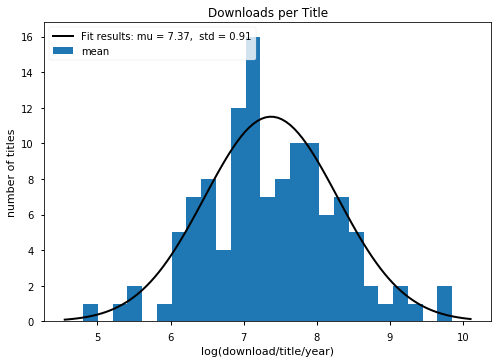
Other times, the existence of "outliers" is evidence that the numbers are better measured and compared on a different scale. Often, that's a logarithmic scale. For example, noise is measured on a logarithmic scale, in units of decibels. An ambulance siren has a million times the noise power of normal conversation, but it's easier to make sense of that number if we compare the 60 dB sound volume of conversation to the 90 dB of a hair dryer, the 120 dB of the siren and the 140 dB of a jet engine. Similarly, we can understand that while J.K. Rowling's sales run into 8 figures, most top Gloucestershire-born authors are probably 3, 4 and or maybe 5 figure sellers.

Over the weekend, I released a "preprint" on Humanities Commons, describing my analysis of open-access ebook usage data. I worked with a wonderful team including two open-access publishers, University of Michigan Press and Open Book Publishers, on this project, which was funded by the Mellon Foundation. To boil down my analysis to two pithy points, the preprint argues:

  1. Free ebook downloads are best measured on a logarithmic scale, like earthquakes and trade publishing sales.
  2. We shouldn't average download counts.

If you take the logarithm of book downloads, the histogram looks like a bell curve!
For example, if someone tries to tell you that "Engineering, mathematics and computer science OA books perform much better than the average number of downloads for OA books across all subject areas" without telling you about variances of the distributions and refusing to release their data, you should pay them no mind.

Next week, I'll have a post about why logarithmic scales makes sense for measuring open-access usage, and maybe another about how log-normal statistics could save civilization.

Thursday, December 27, 2018

Towards Impact-based OA Funding

Earlier this month, I was invited to a meeting sponsored by the Mellon Foundation about aggregating usage data for open-access (OA) ebooks, with a focus on scholarly monographs. The "problem" is that open licenses permit these ebooks to be liberated from hosting platforms and obtained in a variety of ways. A scholar might find the ebook via a search engine, on social media or on the publisher's web site; or perhaps in an index like Directory of Open Access Books (DOAB), or in an aggregator service like JSTOR. The ebook file might be hosted by the publisher, by OAPEN, on Internet Archive, Dropbox, Github, or Unglue.it. Libraries might host files on institutional repositories, or scholars might distribute them by email or via ResearchGate or discipline oriented sites such as Humanities Commons.

I haven't come to the "problem" yet. Open access publishers need ways to measure their impact. Since the whole point of removing toll-access barriers is to increase access to information, open access publishers look to their usage logs for validation of their efforts and mission. Unit sales and profits do not align very well with the goals of open-access publishing, but in the absence of sales revenue, download statistics and other measures of impact can be used to advocate for funding from institutions, from donors, and from libraries. Without evidence of impact, financial support for open access would be based more on faith than on data. (Not that there's anything inherently wrong with that.)

What is to be done? The "monograph usage" meeting was structured around a "provocation": that somehow a non-profit "Data Trust" would be formed to collect data from all the providers of open-access monographs, then channel it back to publishers and other stakeholders in privacy-preserving, value-affirming reports. There was broad support for this concept among the participants, but significant disagreements about the details of how a "Data Trust" might work, be governed, and be sustained.

Why would anyone trust a "Data Trust"? Who, exactly, would be paying to sustain a "Data Trust"? What is the product that the "Data Trust" will be providing to the folks paying to sustain it? Would a standardized usage data protocol stifle innovation in ebook distribution? We had so many questions, and there were so few answers.

I had trouble sleeping after the first day of the meeting. At 4 AM, my long-dormant physics brain, forged in countless all-nighters of problem sets in college, took over. It proposed a gendanken experiment:
What if there was open-access monograph usage data that everyone really trusted? How might it be used?
The answer is given away in the title of this post, but let's step back for a moment to provide some context.

For a long time, scholarly publishing was mostly funded by libraries that built great literature collections on behalf of their users - mostly scholars. This system incentivized the production of expensive must-have journals that expanded and multiplied so as to eat up all available funding from libraries. Monographs were economically squeezed in this process. Monographs, and the academic presses that published them, survived by becoming expensive, drastically reducing access for scholars.

With the advent of electronic publishing, it became feasible to flip the scholarly publishing model. Instead of charging libraries for access, access could be free for everyone, while authors paid a flat publication fee per article or monograph. In the journal world, the emergence of this system has erased access barriers. The publication fee system hasn't worked so well for monographs, however. The publication charge (much larger than an article charge) is often out of reach for many scholars, shutting them out of the open-access publishing process.

What if there was a funding channel for monographs that allocated support based on a measurement of impact, such as might be generated from data aggregated by a trusted "Data Trust"? (I'll call it the "OA Impact Trust", because I'd like to imagine that "impact" rather than a usage proxy such as "downloads" is what we care about.)

Here's how it might work:

  1. Libraries and institutions register with the OA Impact Trust, providing it with a way to identify usage and impact relevant to the library or institutions.
  2. Aggregators and publishers deposit monograph metadata and usage/impact streams with the Trust.
  3. The Trust provides COUNTER reports (suitably adapted) for relevant OA monograph usage/impact to libraries and institutions. This allows them to compare OA and non-OA ebook usage side-by-side.
  4. Libraries and institutions allocate some funding to OA monographs.
  5. The Trust passes funding to monograph publishers and participating distributors.

The incentives built into such a system promote distribution and access. Publishers are encouraged to publish monographs that actually get used. Authors are encouraged to write in ways that promote reading and scholarship. Publishers are also encouraged to include their backlists in the system, and not just the dead ones, but the ones that scholars continue to use. Measured impact for OA publication rises, and libraries observe that more and more, their dollars are channeled to the material that their communities need.

Of course there are all sorts of problems with this gedanken OA funding scheme. If COUNTER statistics generate revenue, they will need to be secured against the inevitable gaming of the system and fraud. The system will have to make judgements about what sort of usage is valuable, and how to weigh the value of a work that goes viral against the value of a work used intensely by a very small community. Boundaries will need to be drawn. The machinery driving such a system will not be free, but it can be governed by the community of funders.

Do you think such a system can work? Do you thing such a system would be fair, or at least fairer than other systems? Would it be Good, or would it be Evil?

Notes:
  1. Details have been swept under a rug the size of Afghanistan. But this rug won't fly anywhere unless there's willingness to pay for a rug.
  2. The white paper draft which was the "provocation" for the meeting is posted here.
  3. I've been thinking about this for a while.

Monday, March 7, 2016

Inside a 2016 Big Deal Negotiation...


Dramatis Personae: 
  • A Sales Representative from STM Corporation
  • An Acquisitions Librarian at Prestige University.

STM Corp Sales Rep: It's so nice to see you! We have some exciting news about your Big Deal renewal contract!

PU Acquisitions Librarian: Actually, I'm afraid we have some bad news for you. The Acquisitions Committee has had to make some cutbacks...

Sales Rep: I'm sorry to hear that. In fact, we also have some disturbing data to show you.

Librarian: We've been studying our usage data, and STM Corp's journals aren't seeing the usage we'd expected.

Sales Rep: Funny you should mention that, because STM Corp's Big Deal service has implemented a new "Total Information Awareness (TIA)" system that will answer all your usage questions. The TIA system monitors usage of our articles however they are acquired, and pinpoints the users, whoever and where ever they are. Our customers have been wanting this information for years, and now we can provide it.

Librarian: Now that's interesting. We've been discussing whether that sort of data could improve our services, but as librarians we need to respect the privacy of our users.

Sales Rep: Of course! And as publishers, we need to protect our services from unauthorized access and piracy.

Librarian: ... and our license agreements oblige us to respond to those concerns.

Sales Rep: I'm so glad you understand! But the TIA has exposed some disturbing information about journal usage on your campus.

Librarian: Yes, usage is dropping, That's what we wanted to discuss with you.

Sales Rep: Actually, total usage is increasing. It's just licensed usage that's dropping. Illicit usage is going through the roof!

Librarian: What do you mean?

Sales Rep: Have you heard of a website called Sci-Hub?

Librarian: [suppressing smile] Why yes...

Sales Rep: It seems that students and faculty on your campus have been accessing our articles via Sci-Hub quite a lot, and have been uploading...

Librarian: [starting to worry] We would never condone that! Using articles from Sci-Hub is likely copyright infringement in our jurisdiction. And uploading articles would be a violation of our campus policies!

Sales Rep: Exactly! Which is why we wanted you to see this data.

Librarian: [scanning several pages] But.. but this is a list of hundreds of our students and faculty, including some of our most prominent scientists!

Sales Rep: [grinning] ... each of them potentially facing hundreds of thousands of dollars of statutory damages for copyright infringement. Even career-ending litigation. It's such a blessing for you that we would never pursue legal actions that would hurt a good customer like Prestige U. Now about your renewal...

Librarian: Where did this list come from?

Sales Rep: As I said before, STM Corp's "Total Information Awareness" system monitors usage of our articles and pinpoints the users. You said before you had some bad news for us?

Librarian: Umm... we need to make some cutbacks.

Sales Rep: [smug] Well, then you'll be happy to know that we're limiting your big deal price to just a 19% increase over last time.

Librarian: [non-gendered expression of profound despair] ... and our Dean who's been using Sci-Hub?

Sales Rep: Sci-Hub? never heard of it.

Librarian: [resigned] OK, send us the invoice.

[Everything in this drama is fictitious except Sci-Hub and TIA. more next time.]

Thursday, October 22, 2015

This is NOT a Portrait of Mary Astell

Not Mary Astell, by Sir Joshua Reynolds
Ten years ago, the University of Calgary Press published a very fine book by Christine Mason Sutherland called The Eloquence of Mary Astell, which focused on the proto-feminist's contributions as a rhetorician. The cover for the book featured a compelling image using a painted sketch from 1760-1765 by the master English portraitist Sir Joshua Reynolds, currently in Vienna's Kunsthistorisches Museum and known as Bildnisstudie einer jungen Dame (Study for the portrait of a young woman).

Cover images from books circulate widely on the internet. They are featured in online bookstores, they get picked up by search engines. Inevitably, they get re-used and separated from their context. Today (2015) "teh Internetz" firmly believe that the cover image is a portrait of Mary Astell.

For example:

If you look carefully, you'll see that the image most frequently used is the book cover with the title inexpertly removed.

But the painting doesn't depict Mary Astell. It was done 30 years after her death. In her book, Sutherland notes (page xii):
No portrait of her remains, but such evidence as we have suggests that she was not particularly attractive. Lady Mary Wortley Montagu’s granddaughter records her as having been “in outward form [...] rather ill-favoured and forbidding,” though Astell was long past her youth when this observation was made. 

Wikipedia has successfully resisted the misattribution.

A contributing factor for the confusion about Mary Astell's image is the book's failure to attribute the cover art. Typically a cover description is included in the front matter of the book. According to the Director of the University of Calgary Press, Brian Scrivener, proper attribution would certainly be done in a book produced today. Publishers now recognize that metadata is increasingly the cement that makes books part of the digital environment. Small presses often struggle to bring their back lists up to date, and publishers both large and small have "metadata debt" from past oversights, mergers, reorganizations and lack of resources.

Managing cover art and permissions for included graphics is often an expensive headache for digital books, particularly for Open Access works. I've previously written about the importance of clear licensing statements and front matter in ebooks. It's unfortunate when public domain art is not recognized as such, as in Eloquence, but nobody's perfect.

The good news is that University of Calgary Press has embraced Open Access ebooks in a big way. The Eloquence of Mary Astell and 64 other books are already available, making Calgary one of the world's leading publishers of Open Access ebooks. Twelve more are in the works.

You can find Eloquence at the Calgary University Press website (including the print edition), Unglue.it, DOAB, and Internet Archive. Mary Astell's 1706 pamphlet Reflections Upon Marriage can be found at the Internet Archive and at the University of Pennsylvania's Celebration of Women Writers.

And maybe in 2025, teh internetz will know all about Sir Joshua Reynold's famous painting, Not Mary Astell. Happy Open Access Week!

Monday, September 22, 2014

Attribution Meets Open Access

Credits Dancer (see on YouTube)
It drives my kids crazy, but I always stay for the credits after the movie. I'm writing this while on a plane over the Atlantic, and I just watched Wes Anderson's Grand Budapest Hotel. Among the usual credits for the actors, the producers, the directors, writers, editors, composers, designers, musicians, key grips, best boys, animators, model makers and the like, Michael Taylor is credited as the painter of "Johannes von Hoytl's Boy with Apple" along with his model, Ed Munro. "The House of Waris" is credited for "Brass Knuckle-dusters and Crossed Key Pins". There's a "Drapesmaster", a Millener and two "Key Costume Cutters". There are even "Photochrom images courtesy of The Library of Congress". To reward me for watching to the end there's a funny Russian dancer over the balalaika chorus.

It says a lot about the movie industry that so much work has gone into the credits. They are a fitting recognition of the miracle of a myriad of talents collaborating to result in a Hollywood movie. But the maturity of the film industry is also reflected in the standardization of the form of this attribution.

The importance of attribution is similarly reflected by its presence is each of the Creative Commons licenses. But many of the digital media that have adopted Creative Commons licensing have not reached the sort of attribution maturity seen in the film industry. The book publishing industry, for example, hides the valuable contributions of copy editors, jacket designers, research assistants and others. It's standard practice to attribute a work to the author alone. If someone spends time to make an ebook work well, that generally doesn't get a credit alongside the author.

The Creative Commons licenses require attribution, but don't specify much about how the attribution is to be done, and it's taken a while for media specific conventions to emerge. It seems to be accepted practice, for example, that CC licensed blog posts require a back-link to the original blog post. People who use CC licensed photos to illustrate a slide presentation typically have a credits page with links to the sources at the end.

Signs of maturation were omnipresent at the 6th Conference for Open Access Scholarly Publishing, which I'm just returning from. Prominent in the list of achievements was the announcement of a "Shared Statement and Community Principles on Expectations of Scholarly Standards on Attribution", a set of attribution principles for open access scholarly publications, signed by all the important open access scholarly publishers.

The four agreed-upon principles are as follows:

  1. Researchers choosing Open Access and using liberal licenses do so because they wish to maximise access to and re-use of their work. We acknowledge the tradition of both freely giving knowledge to our communities and also the expectation that contributions will be respected and that full credit is given according to scholarly norms.
  2. Authors choose Creative Commons licenses in part to ensure attribution and the assignment of credit. The community expects that where a work is reprinted, collected, aggregated or otherwise re-used substantially as a whole that the original source, location and free availability of the original version will be both made explicit and emphasised.
  3. The community expects that where modifications have been made to an article that this will be made explicit and every practicable effort will be made to make the nature and scope of modifications explicit. Where a derivative is digital all practicable efforts should be made to make comparison with the original version as easy as possible for the user.
  4. The community assumes, consistent with the terms of the Creative Commons licenses, that unless noted otherwise authors have not endorsed any republication or modification of their original work. Where authors have explicitly endorsed the republication or modified version this should be made explicit in a way which is separate to the attribution.

These principles, and the implementation guidelines that will result from further consultations, are particularly needed because many scholars, while supporting the reuse enabled by CC BY licenses, are concerned about possible misuse. The principles reinforce that when a work is modified, the substance of the modifications should be made clear to the end user, and that further, there must be no implication that republication carries any endorsement by the original authors.

One thing that is likely to emerge from this process is the use of CrossRef DOI's as attribution urls. DOIs can be resolved (via redirection) to an authoritative web and can be maintained by the publisher so that links needn't break when content moves.

As scholarly content gets remixed, revised and repurposed, there will increasingly be a need to track contributions every bit as elaborate as for Grand Budapest Hotel. Imagine a paper by Alice analyzing data from Bob on a sample by Carol, with later corrections by Eve. Luckily we live in the future and there's already a technology and user framework that shows how it can be done. That technology, the future of attribution (I hope), is Distributed Version Control. A subsequent post will discuss why every serious publisher needs to understand GitHub.

The emphasis on community in the the "Shared Statement" is vitally important. With consultation and shared values, we'll soon all be dancing at the end of the credits.

Sunday, June 29, 2014

Is Freemium Really Open Access?

Should the term "Open Access" be restricted to materials with licenses that allow redistribution, like Creative Commons licenses? Or, as some advocate, only materials that allow remixing and commercial re-use, like CC-BY and CC-BY-SA?

I had lunch today with folks from OpenEditions, a French publishing organization whose ebook effort I've been admiring for a while. They're here in Las Vegas at the American Library Association Conference, hoping to get libraries interested in the 1,428 ebooks they have on their platform. (Booth 1437!)

Of those 1,076 books are in a program they call "Open Access Fremium". With these books, you can read them on the OpenEditions website for free, without having to register or anything. You can even embed them into your blog. So for example, here's Opinion Mining et Sentiment Analysis by Dominique Boullier and Audrey Lohard:


So is it OpenAccess™?

In this freemium model, the main product that's being sold is access to the downloadable ebook- whether PDF or EPUB. For libraries, a subscription allows for unlimited access with IP address authentication along with additional services. Creative Commons licenses, all of which allow for format conversion, wouldn't work for this business model because the free HTML could easily be converted into EPUB and PDF. They have their own license, you can read it here.

This is clearly not completely open, but there's no doubt that it's usefully open. For me, the biggest problem is that if OpenEditions goes away for some reason- business, politics, natural disaster, or stupidity, then the ebooks disappear. Similarly, if OpenEditions policies change or urls move, they could break the embed.

On the plus side, OpenEditions have convinced a group of normally conservative publishers of the advantages of creating usefully open versions of over a thousand books. It's a step in the right direction.


Friday, February 28, 2014

Open Access Honesty

I've spent a large part of February becoming acquainted with Open Access ebook publishers. And the one thing that troubles me is that too many of them are not putting honesty first. Because existing distribution channels do not reward forthrightness in Open Access publishers; in fact the channels actively discourage it.

Let's take Amazon, for example. They don't like free ebooks, because there's no money in it for them. If you're a publisher and you want your ebook to be free for people to load onto their kindles, Amazon will charge you for the privilege. They rationalize that they're paying for a separate wireless network, "Whispernet", so it's only fair to assess "delivery charges" to free  ebook publishers. If you use their 70% royalty option, the delivery charge is 15 cents per MB of data, and the minimum price you can set is 99 cents. The only way to get Amazon to deliver your ebook for free is to select their 35% royalty option, and then invoke this "matching Competitor Pricing" clause:
From time to time your book may be made available through other sales channels as part of a free promotion. It is important that Digital Books made available through the Program have promotions that are on par with free promotions of the same book in another sales channel. Therefore, if your Digital Book is available through another sales channel for free, we may also make it available for free. If we match a free promotion of your Digital Book somewhere else, your Royalty during that promotion will be zero. (Unlike under the 70% Royalty Option, if we match a price for your Digital Book that is above zero, it won't change the calculation of your Royalties indicated in C. above.)
Apple, Kobo, and Google are much happier to set prices to zero, because they make some money on hardware sales or advertising, so you can get Amazon to give your ebook away for free by getting people to report your zero price on Apple, Kobo, and Google.

So just to get your ebook to be free on Kindle, you're forced to be incompletely honest with your customers and distributers.

But Amazon creates a great temptation. Why not use the suckers paying on Kindle to subsidize the free availability for those smart users who come to  your website? Isn't it convenience that these people are happily paying for?

And libraries are another temptation. They'll pay for the convenience of getting your ebook though their preferred platform, Overdrive or whatever, even as you offer the book for free to users at all the libraries that don't pay for your ebook. But would they still buy if they knew they could get the ebook for free? Maybe you shouldn't ask questions when you don't want to know the answer.

So here's my simple, unproven postulate: in the long run, full disclosure about pricing and an honest relationship with readers will be in the best, mutual interests of authors, publishers, readers, and libraries. And customers will prefer a distribution channel that enables that honesty.

Stop laughing.

Tuesday, October 29, 2013

eBook Heaven

Do you believe in heaven?

Well, why not? There are many ways to think about heaven. Most people will admit that there's something of us that lives on after we die, even if it's just the memories that we leave in others or the impact of our lives on the material world. And whatever that something is, it doesn't need food to eat or even air to breathe. It certainly doesn't require a paycheck. Truth and beauty and wisdom, those qualities don't really die with our bodies, do they? If the bit that we leave behind has of its essence some truth or beauty or wisdom, doesn't that sound like heaven?

If you have a favorite library, you know what book heaven is like. Words can live on long after their creators have turned to dust. Libraries work each and every day to bring all the truth, beauty and wisdom in their collections to their communities, both present and future. They cooperate with each other, so that even if your library is missing the book you need, another will fill the void. The rules governing our society have recognized how important all this is, and allow us all to benefit from the labors of those whose existence has faded to memories.

I believe in ebook heaven. In ebook heaven, there are no royalties to pay to Herman Melville or William Shakespeare or Dante Alighieri.  There's even a slushpile in ebook heaven, where the weight of the world presses a diamond or two from unpublished graphene sheets.

The ebook heaven I believe in – some call it Open Access.

There's ebook hell, too, and that's what libraries live today. In ebook hell, books don't live forever, they disappear after a year. Or they're snatched into the kindles of eternal damnation by digital rights demons, lawyers and engineers. Every read must be monetized to feed some hungry monstrosity, and truth and beauty and wisdom are memories like the smells of leather bindings and musty paper.

Or maybe it's ebook purgatory. Dante imagined purgatory as a mountain that souls must climb before being admitted into paradise. In each circle around the mountain, the deadly sins that have stained the souls – envy, greed, lust, etc. – are purged by suffering, sanctified by fire and purified by agony. At last, the remains enter into the Garden of Eden, where everything has returned to its original perfection.


As we look to the future of ebooks, all we can see today is a long circle of purgatory. Our copyright theology posits that we must track millions, perhaps hundreds of millions of creators and their deaths into the far future so that we may say if a work has passed into ebook heaven. In more circles around Purgatorio mountain, we must track national boundaries, regional rights, governing laws, inheritance claims, contract disputes, international conventions, and perhaps even patent rights.

But still, I believe in ebook heaven.

Libraries are still endeavor to create little circles of ebook paradise. Within the bubble of a library, ebooks can be free to read. Digital archivists see that some books really do outlast us. New generations of minds encounter all sorts of new knowledge and enlightenment.

Libraries still work with each other to connect their bubbles and make their ebook paradises bigger. We need to enlarge those heavens, book by book, year by year, library by library. And we can't restrict ebook paradise to academia, any more than a belief system can restrict spiritual paradise to its priesthood. We need to find ways to expand the boundaries of availability for every book, to build bridges between today's best sellers and the far future of the public domain.

eBook heaven is worth working towards, together.

Do you believe in it?

Enhanced by Zemanta

Tuesday, July 30, 2013

Proposal: The Dated Creative Commons License

Back on June 15, Peter Suber's book Open Access itself went open access, one year after its initial publication. You can get the ebook for free from MIT Press, but because of the Creative Commons license you can also get it from Internet Archive, and Unglue.it has a page to help you download it. It seems appropriate for this book to be its own publishing experiment, and from what I hear, the book has done well, in addition to doing good.

The "embargoed" or "delayed" model for open-access is tried and true in the scholarly journal business, and arguments about the appropriate length and propriety of embargoes are entrenched. In medical research, funding agencies such as NIH  demand embargoes of no longer than 12 months,  while humanities publishers argue that they need longer embargoes. Recently, the American Historical Association recommended that doctoral students be allowed to embargo their dissertations for up to six years. (Suber's book discusses delayed open access and embargoes in chapter 8, Casualties.)

Delayed open access for books, by contrast, is almost nonexistent. For ebooks, it would seem that an exclusive selling period followed by Creative Commons licensing could unlock a lot of value for society, and not just for scholarly works. Most books do most of their sales in the first year of publication and not much after that. The current duration of copyright, typically more than a hundred years, seems disproportionate in comparison. Used book stores capture some of the residual value of print books without profit to the rights holder, and libraries help to preserve another chunk of value. The lack of first-sale rights for ebooks leaves huge doubts about the viability of these channels for ebooks.

MIT Press accomplished the delayed open access with a promise on the copyright page of the ebook. Readers could rely on the integrity and prestige of MIT Press to make good on that promise. Wouldn't it be nice if doing something similar was easy to do for any sort of work, just like attaching a copyright date? Suppose I wanted exclusive rights to this blog post for five years, it would be nice if I could just write "(CC BY 2018)" with a url to provide the legal code.

I don't think I can really do that easily, today. Without some sort of license language, nothing would prevent me from changing my mind, so my prospective license offer would not be reliable. Today's Creative Commons licenses depend on conveyance of the license and assume immediate effect.  In the publishing world, companies go bankrupt or get acquired all the time. If Elsevier had acquired MIT Press in May, a purchaser of the book in April would have no assurance that the book would really go Open Access in June. This is not such an issue with journals because they're continuing publications.

Although I'm not a lawyer or anything, I've taken a first stab at language for applying a future date to a Creative Commons license. I've used Docracy to make the document public so that anyone can make modifications to improve it. (If you do a lot of contracts and you haven't seen Docracy, I suggest you go check it out!)  Or maybe other people have worked on this and can contribute some better language.

The beauty of Creative Commons is that it gives creators more options for distributing their works in partnership with users. A robust way of granting future CC licenses will allow more creators to vote with their works for mitigation of over-long terms-of-copyright.

Update: a quick comment from Timothy Vollmer points to a thread on [cc-licenses] that's very relevant, including some interesting discussion of the mysteriously named "Founder's License".

Update 2: James Grimmelmann, a real law professor, suggests via Twitter that "It is not out of the question that one could unilaterally enter into a binding future license at present." and points to the language he used on a 2005 Yale Law Journal Note:
Copyright © 2005 by The Yale Law Journal Company, Inc. For classroom use information, see http://www.yalelawjournal.org/about.asp. After June 1, 2006, this Note is licensed under the Creative Commons Attribution 2.0 License, http://creativecommons.org/licenses/by/2.0/. Any use under this license must carry the notation “First published in The Yale Law Journal, Vol. 114, pp. 1719-58.”
This suggests that maybe I'm making things too complicated, which wouldn't be the first time. But I wish Creative Commons or someone would just tell us what to do!

Update August 9: I've written more about what we want to do with Dated CC at Unglue.it.

Friday, July 26, 2013

Does Asking for Money on Scribd Negate Creative Commons?

I think it does.

This is a quick post motivated by a balky comment system on Chronicle of Higher Education. There, Prof. Adeline Koh explores options available to scholars who want to make their dissertations publicly available. Koh chose Scribd to distribute her dissertation, Inventing Malayanness: Race, Education and Englishness in Colonial Malaya, and also chose to use the Creative Commons BY-NC-ND. So far, so good. Scribd is a perfectly good channel for distributing non-commercial content; CC BY-NC-ND is a perfectly honorable license for a dissertation. (Though I think CC BY-SA is much better in most use cases.)

But Koh used Scribd to set a download price of $2.99 on her dissertation. She has an absolute right to offer her work for sale under the license she chose. But there's a problem. Asking for money converts the Scribd offering to "Commercial Content", and thus invokes a bunch of provisions of the "Scribd Paid Access End User License Agreement", which users must agree to in order to purchase a download. This agreement states quite clearly
  • You may not sell, distribute, or display any Scribd Commercial Content other than for personal use; 
  • You may not share, lend, or rent copies of Scribd Commercial Content;
  • You may not disable or circumvent DRM supplied with Scribd Commercial Content; 
  • You may not make copies of all or any portion of any Scribd Commercial Content;
These conditions are in clear conflict with the specified Creative Commons License, and negate its intent. I am not a lawyer, but I'm pretty sure that if I tried to exercise my Creative Commons rights to a work I purchased from Scribd, Scribd could find a lawyer to sue me for doing so. 

All things considered, I think that use of Scribd in this circumstance is an attack on the integrity of the Creative Commons license. It does not reflect well on Prof. Koh, though she's clearly trying to do the right thing; more academics should be thinking about these issues. If she really wants to apply a Creative Commons license, she should be aware that anyone should be able to take their copy and make it available for download on a non-commercial site such as Internet Archive.

It's a shame that legal ambiguities and technicalities are preventing Creative Commons licenses from being as useful as they might be. Maybe we can get Scribd to clarify the EULA to accommodate situations like this.

Update August 2: Here's the response from Scribd.


Jason (Support Desk)
Aug 02 09:30 am (PDT)
Hi,
The Scribd EULA declares "You may not share, lend, or rent copies of Scribd Commercial Content" under the assumption that most Commercial Content is posted with a standard copyright. Copyright licenses, including any Creative Commons add-ons, are set by the uploader. The uploader is the ultimate authority on a document's distribution license. Scribd takes no position on distribution license set by the uploader. If you have specific questions about copying or redistributing a particular document, please contact the uploader. I suggest leaving a note on the document page and the uploader will be notified.
Best regards,
Jason Bentley
Scribd, Inc.
So my answer to "is the CC license negated?" changes to "No, it's just muddied a bit".
Enhanced by Zemanta

Wednesday, October 31, 2012

Library Connections to Open Access eBooks

Power refugees at Montclair Public Library
Hurricane Sandy came through the other night and took away power for 90% of my New Jersey town. The one thing we miss, the one thing we ache for, is the connectedness we get from our devices. We're fine as long as we can keep our cell phones charged.

During my month-long tour telling people about Unglue.it, I've been challenging librarians to start thinking of themselves as connectors, not collectors. In an era of information abundance, library systems and processes that focus on managing an inventory of scarce resources are becoming less useful. The ability to connect a library user to the right information is becoming correspondingly more important.

Here's a crime scene we need to eradicate. A student comes into the library with a device, and asks for Moby Dick. It's been assigned reading, so all the print copies are checked out. Does the library have it as an ebook? Too often, there's no Moby Dick ebook listed in the library's catalog. The library depends on a commercial service to serve ebooks to its users, but the annotated ebook of Moby Dick that the library has licensed is checked-out. "Sorry, we don't have it" the student is told.

This should NEVER happen. Melville's Moby Dick: or The Whale belongs to all of us. Project Gutenberg has an excellent version, in formats that work on just about any device. But because it's free, no one has a monetary incentive to make that connection.

The barriers that libraries have put in place that prevent them from making use of open-access ebooks are mostly not intentional, but it will take some work to make them go away; it's something I've been working on since  the September release of the unglued edition of Oral Literature in Africa. I've been talking to the library automation and ebook platform vendors, who I know from my years in the library technology business. Without exception, the people I've talked to are enthusiastic about supporting unglued and other open-access ebooks, but there are lots of barriers. Their systems have been hard-wired to assume that library ebooks will always have digital rights management, or can only be used one user at a time. These restrictions are incompatible with the Creative Commons license we're using for unglued ebooks.

There's not much awareness of the no-DRM provisions of Creative Commons licenses, but it's there, in section 4(a):
When You Distribute or Publicly Perform the Work, You may not impose any effective technological measures on the Work that restrict the ability of a recipient of the Work from You to exercise the rights granted to that recipient under the terms of the License. 
This clause also serves as a barrier to commercial use by people other than the rights holder, even for the licenses that allow commercial use. For example, the Kindle store automatically applies DRM, so unless you have permission from the rights holder, you can't sell someone else's Creative Commons licensed ebook in the Kindle store.

It will take some time and a lot of work, but eventually the library barriers to Open Access ebooks will fall. But until then libraries need to ask their vendors to give these changes a high priority. Libraries that are investigating new systems for ebook distribution need to add requirements in their RFPs for serving open access ebooks along side print and pretend-its-print books.

Hurricane Roll - by Tony
There are also barriers barriers preventing libraries from using these resources that are created by libraries themselves. Libraries have many processes and workflows surrounding resource acquisition, circulation, and evaluation that overlook the opportunity to serve users with free resources. While academic libraries have been thinking about ways to support open-access academic journals for years now, books are different. Book acquisition is often funded through approval plans and selection committees that don't consider the availability of free resources, no matter their quality. And if a library measures its performance using circulation numbers which don't include connections to free resources, then how often will then resources be supported?

Connections can occur in many ways. Today, I'm connected my laptop power at the library along with more than 254 other refugees deprived of power and internet by Sandy. I know it's more than 254 because my laptop couldn't get an IP address on the WiFi. So I went to the sushi bar/cafe down the street, connected to the wifi, and ordered a "Hurricane Roll". And clicked "publish".

Wednesday, October 17, 2012

OA CC-BY MIT WTF?

©FUBAR

Update:
MIT Press revised the Copyright page for the ebook version. I've scraped it for you:


© 2012 The MIT Press. All rights reserved. Subject to the Creative Commons licenses noted below, no part of this book may be reproduced, transmitted, or displayed by any electronic or mechanical means without permission from The MIT Press or as permitted by law.


This book incorporates certain materials previously published under a CC-BY license and copyright in those underlying materials is owned by SPARC.


Effective June 15, 2013, this book will itself be subject to a CC-BY-NC license.

For information about special quantity discounts, please email special_sales@mitpress.mit.edu.

Library of Congress Cataloging-in-Publication Data
Suber, Peter.
Open access / Peter Suber.
   p. cm. — (MIT Press essential knowledge)
 
Includes bibliographical references and index.
ISBN 978-0-262-51763-8 (pbk.: alk. paper)
ISBN 978-0-262-30098-8 (retail e-book)
1. Open access publishing. I. Title.
Z286.O63S83 2012
070.5'7973—dc23
2011038297

Sunday, August 26, 2012

The "I Used This" Button


I frequent-flyered off to San Francisco this weekend to surprise my Ph. D. Advisor, Jim Harris, for his 70th Birthday. I was the first of his students to graduate, and he's up to 105. On thing I learned helping to start his group was the immense value of being thrown together with a group of smart people with a variety of experience. I met members of Jim's current group, which includes a student from Gunn High School, visiting scholars from around the world, and Ph. D. students bursting with ideas.

I manufactured some business-related meetings for the trip, some of which I'll relate in a to-be-written post, but I also lucked into a hackathon for Open-Access hosted by PLoS. I spent the day with a group of smart people with a wide range of experience, including software developers, product managers, film-makers and a librarian or three.

The group I ended up working with included Greg Grossmeier from Creative Commons, Cameron Neylon from PLoS, and Ana Nelson, the developer-entrepreneur behind dexy. We were interested in counting open-access things. Counting things can be harder than you think, because you have to define the things and identify them; you need to be able to tell whether a thing is the same thing as another thing, or perhaps it's three things. Counting bananas is one thing, but have you ever tried counting ideas?

Creative Commons (CC) is interested in knowing how much its licenses are used. When an Unglue.it ebook edition is released (of course under Creative Commons!), how often is it used? Does a single license apply to the entire book, or can we apply different licenses to the different resources inside the book? For example, an author may want to use a CC-BY license for the text of a book, which might contain figures that are used under CC BY-ND. And the metadata should be CC0. How should these licenses be expressed?

After some discussion, we settled down to work on some specific projects. My project turned out not to be code at all, but rather a description of a scheme for measuring Creative Commons usage, i.e. the rest of this blog post.

Creative Commons has thought about ways to measure the usage of its licenses. For example, it can track the display of its license "badges", such as the one right here. Web browsers will send a referrer header that tells the image server the web page and user IP address. But there are problems. Many web sites use their own copy of the badge. In an ebook, the badge would be embedded in the ebook file. If the page is served over a secure socket, the referrer won't be set. And do you really want to tell Creative Commons about everything you're reading?

Speaking of which, have you clicked on a Facebook "Like" button this week? Was it good for you too?

Suppose there was a button on Creative Commons licensed documents that allowed the user to express their delight at the creator's enlightened choice of license. Would you click it? I call it the "I Used This" (IUT) button, but maybe you can think of a better name.

  • The IUT button would send a signal to a Creative Commons server about usage of the resource. These signals would be compiled and reported.
  • IUT button would also send attribution url.
  • Pressing the button would display an amusing animation to the user. Perhaps every button would have a different animation to avoid button fatigue.
  • The button would be at the center of an advocacy campaign for open licenses.
  • Unlike the Facebook Like button, the IUT button would respect a user's privacy. A signal would be sent only when initiated by the user, and would be optional.
  • An IUT button packaged as a javascript would work in epub, html, etc.
  • IUT signals would be evidence of the resource's status as a CC licensed work. A licensor attempting to revoke a CC license (you can't do that!) would have to overcome a verifiable usage trail.
  • Users could create accounts at CC to provide a retrospective record of the user's Use.
  • Clicking the IUT Button would put the attribution url on clipboard to ease correct citations.
  • Usage information for each resource would be public- creators could easily track the usage signals for their works.
  • We might need anti-ballot-stuffing measures if CC usage rankings become commercially important.

If efforts like Unglue.it are to succeed, people who appreciate the benefits of Creative Commons licensing need to stand up and be counted. We need to make it a mass movement in the minds of every lover of books, everywhere.

Sometimes you need to do more than just consume. Sometimes you need to do some SHOUTING.

Enhanced by Zemanta