Saturday, November 6, 2010

Consumer Interest in Pirated eBooks is Even Lower Than I Thought

My recent posts following up on Attributor's most recent study on demand for pirated ebooks have been republished on TeleRead, probably the longest running blog covering ebooks and related topics. Paul Biba, the current editor, has been doing a great job bringing together interesting articles from many different perspectives.

The Teleread discussion on my article Attributor ebook piracy numbers don’t add up had some interesting contributions. Jim Pitkow, CEO of Attributor, suggested that the difference between the data I got from Google AdWords and Attributor's data might be a result of a difference in methodology. While I used Google's predicted traffic numbers, Attributor used numbers from an actual AdWords campaign. For example, Attributor bought the keyword “lost symbol free ebook” along with 868 others and counted how many impressions were generated by Google.

AdWords predicts a total query volume of 62 per day for the keyword “lost symbol free ebook”. If each of the other keywords did the same volume of queries, Attributor should have seen 53,900 impressions per day for its ad campaign. It's not at all clear how 53,900 impressions turns into 1.5-3 millions searches for pirated content; that would be a factor of 30-60 larger than the traffic predicted by the AdWords estimator tool. Pitkow's comment seemed to suggest that the result of an actual advertising campaign would be different from the estimate, possibly accounting for the discrepancy.

So I did an actual advertising campaign of my own to see if this was true.

I've used AdWords in the past with amazingly cost-effective results. I would spend about five dollars a month at five cents per click to advertise a service that sold for thousands of dollars per year. My experience, albeit somewhat dated, was that the estimator tool overestimated, not underestimated, the actual traffic. I was interested to see if this was still true.

I constructed a "free ebook survey" landing page for my ad campaign, and added StatCounter analytics so I could see who clicked on my ad. I bought the keyword suggested by Pitkow: “lost symbol free ebook”.

AdWords gives you a number of settings to fine-tune your ad campaign. For example, I checked all the boxes for geographical coverage so my ads would be seen in as many countries and languages as possible.

AdWords offers three important options that determine the distribution of the ads. You can choose to advertise on Google only, Google and its "search partners" or on Google, it's search partners, and Google's "display network". I spoke with Pitkow last week, and he indicated that Attributor's study used both Google and its search partners.

The initial results of my ad campaign were alarming. In just four hours, I accumulated 7,000 impressions and 19 clicks; my campaign halted because my bids were too low. This traffic level would easily support Attributor's estimates. But when I looked into it, I found that I had included the "display network" without meaning to. What's more, the referring sites were really junky. I couldn't imagine who would use sites like "Lost World TV", NDParking and Sebaidu. The 61 cents I spent in those four hours may well have gone to a bunch of sites engaging in click fraud.

A full week of advertising on just Google, by contrast, resulted in a grand total of 15 impressions, much less than Googles estimate of 62 per day. I next added Google's search partners to my campaign, and got an impression rate about three times higher.

Even with the search partners, the reported search volume is about a tenth of the predicted volume. I must therefore revise the estimate I made about "consumer demand for pirated ebooks". Instead of 100,000-300,000 searches per day, 10,000-30,000 per day throughout the world seems to be a better estimate.

As a result of this experiment, the Attributor numbers are even more inexplicable than before. It's worth noting however, the one area where there's no disagreement. Both my investigations and Attributor's show that consumer interest in piracy is mostly located outside the US, UK, and Canada. Jane Litte's recent post on the geographical restrictions conundrum for ebooks (and comments thereto) does an excellent job of describing why that may be so.
Enhanced by Zemanta

Sunday, October 31, 2010

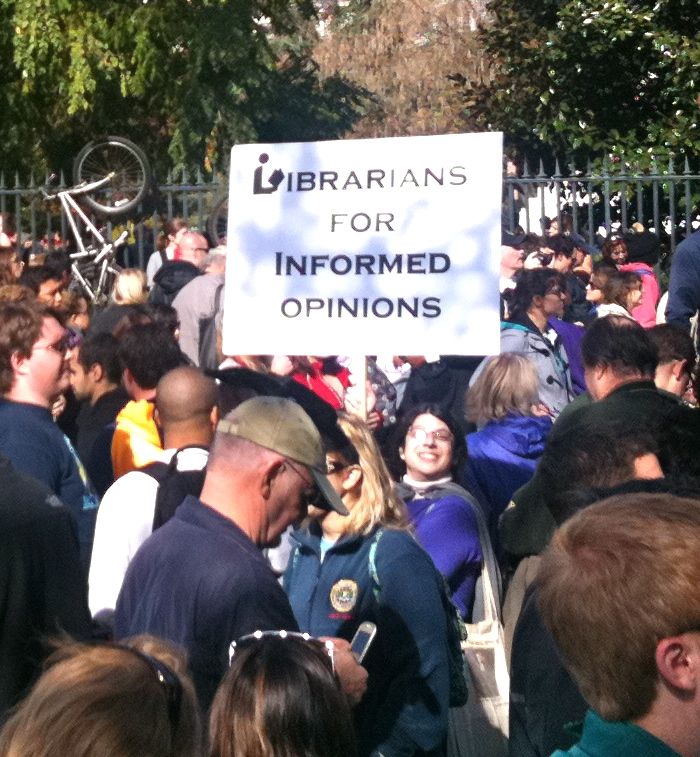
The User-Generated "Rally to Restore Sanity"

I had an inkling that Jon Stewart's "Rally to Restore Sanity" was going to be big a few weeks ago when I tried to make a hotel reservation in Washington, DC and found that no hotel rooms in the city were available this weekend (I had decided to combine a trip to the rally with some other business).

On Saturday morning, I realized that the rally would indeed be something unprecedented; at 9 AM, the inbound Metro Red line train was jam packed with rallygoers at the third stop (Twinbrook), even though nothing was scheduled till 12 AM. By the sixth stop, the train was having difficulty getting its doors closed, leading to delays.

The odd thing about the rally was that there were hardly any instructions as to what we were to do at the "million moderate march", other than to have some fun while engaging is a respectful discourse with other people and being willing to listen. Rallygoers were to make of the event whatever they wished. For some, it was a massive Halloween Party; for others it was a chance to express dismay at the rhetoric of Glenn Beck and Fox News. Whatever it was, there was a widespread feeling of wanting to participate in something historic.

On the train, collective coping behaviors emerged from the unexpected mass intimacy. When we got to stations where one or two riders needed to get off, other riders squeezed aside to make sure they could emerge from the train. Later, above ground, the crowd would make a special effort to part for rallygoers in wheelchairs and parents with children in strollers. Police cars and ambulances drove through streets packed with people because somehow the crowd recognized a necessity.

In the part of the crowd where I ended up, none of us could really hear or see the speeches or entertainment, but nobody seemed to care. We can watch Jon Stewart and Stephen Colbert on TV any evening, and we knew without watching what he might say. It was the rest of the crowd we were there to be with. Close to where I stood, a young man was trying to climb a tree to get a better view; there was already another fellow up in the tree. The crowd took notice, and began to cheer him on. Before long, there was a chant of "YES YOU CAN" that took hold of the crowd, and the fellow in the tree tried his best to help the climber up.

This morning, reading the press accounts, I was dismayed to see that much of the "mainstream media" seemed to miscomprehend the Rally for Sanity by focusing on the show rather than the audience. Whether the rally was 215,000 people or 420,000 people, the media's mistake is akin to reporting that YouTube is a site for stupid pet trick videos. The best way to understand the Sanity Rally's significance, in fact, is to make the analogy that YouTube is to Fox (or CBS, for that matter) as the Rally for Sanity is to almost any previous political rally. Finally, crowdsourcing has come to the crowd.

Nonetheless, when Jon Stewart began to speak at the end of the rally, the crowd suddenly became quiet and strained to hear. "These are hard times, not end times" we heard. There was something about the miracle of the Lincoln Tunnel, where cars strain to get through, merging from 20 lines or so down to two, and it somehow works even though the people in one car might be totally different from the people in the next car, the traffic moves forward concession by sensible concession, and sometimes the light at the end of the tunnel isn't the promised land, it's New Jersey.

But we didn't need Jon Stewart to tell us that, we had discovered that by being pressed together in a massive crowd, and by learning how to get around anyway.
Enhanced by Zemanta

Friday, October 29, 2010

Business Idea #4: Ungluing eBooks

It's been a while since I blogged a business idea for Gluejar. There have been at least three reasons for this hiatus.
  1. Blogging has been fun. Every article generates a bunch of ideas for me to pursue and I just love exploring new ideas and learning about new things. Not to mention the dialogue with readers which has been very stimulating. I've learned a lot.
  2. Since January, I've been working with architects and contractors on an extensive home renovation, which takes up a lot of time and mind share. This work is almost done, so it's time to think about new projects.
  3. Previous ideas smoldered and the heat dissipated. Same with a few other opportunities I looked at.
On the other hand, my recent series of articles on acquiring ebooks into the commons has led me to seriously consider making this into a business. The more I consider the possibilities and the details, the more convinced I become that the job is both viable and important. It's been over 2 months, and the hallucination has not worn off.

For your reference, here are the relevant articles:
The business model for this venture is simple- build, run and promote an ebook bounty market, and charge 5%-ish of closed transactions. The hard part is winning over mass markets of consumers, both individual and institutional. The first step, perhaps the hardest step, is explaining and advocating the concept to people who are only just getting a feel for what ebooks are. "Stealth" is just not going to get that done, so I've decided to be as open as possible about what I'm doing.

So here's a first draft of a home-page pitch/explanation. Let me know what you think.
Unglue Your eBooks!
Have you noticed that your eBooks are stuck inside your proprietary reading device?
Have you noticed that the printed books on your shelves are stuck there, instead of being available on your nifty reading thing?
Have you noticed how hard it is to lend an ebook to someone or to give it to your friends?
Have you noticed that you can't get the ebooks you want through your library?
The problem is glue. Not the kind of glue that binds paper together, but the legal kind that sticks intellectual property to its owners and licensees. Authors need a paycheck so they can devote time and effort to writing books; publishers need income so they can refine those books and make them beautiful. Their problem these days is that the book publishing industry is stuck on an old model of selling individual copies.
Gluejar offers a new way for people who love books to support the people who create books without putting all sorts of licensing glue and restrictions glue on the digital copies. We bring large numbers of book lovers together to financially support the ungluing of the books that they love.
Here's how it works:
  1. Decide how much you want to spend on ungluing your books. The amount is totally up to you; but how about 10% of what you normally spend on books?
  2. Visit our partner sites to decide which books you want to support; you can pledge support for any number of books! Or browse our catalog of books on offer.
  3. You can visit your Gluejar Boookshelf at any time to see the current support level for each of your books.
  4. We won't charge your credit card until supporters have pledged enough money so that rights holders agree to unglue the ebooks you want.
  5. When an ebook is unglued it will appear automatically in your favorite ebook reader account. Once that happens, you can give the ebook to all of your friends and your library can make it available to all of its patrons. 100% legal, anywhere.
  6. Many ebooks come with bonuses for supporters; you might win a dinner with the author, a signed print copy, or maybe just a simple thank you note. We'll email you with details.
As you can see, I've tied the name of the service into the pre-existing Gluejar name for now; at least it's not horrible.

If you want to suggest an alternative pitch, put it in the comments. The best suggestion will win $100 to spend on the Gluejar ebook bounty market!
Enhanced by Zemanta

Wednesday, October 20, 2010

Attributor eBook Piracy Numbers Don't Add Up

In my article on "Consumer Demand for Pirated eBooks", I showed that Google Trends data tells a very different story from the one that anti-piracy services vendor Attributor derived from the very same data. I did not comment, however, on the headline that Attributor gave for its press release. The key finding of the report heralded by that release was that "Daily demand for pirated e-books can be estimated at 1.5-3 million people worldwide." This result has garnered some significant attention, because the number is quite large.

Extracting numbers using the tools used by Attributor is rather involved, and it's taken a while for me to carefully examine the available data. After doing this work, I've decided that when Attributor wrote "can be estimated at 1.5-3 million", they left out the word "blindly". As far as I can tell, Attributor is recklessly inflating the magnitude of ebook piracy; using the very same traffic measurement tools, I estimate the truth to be about 10% of the number they claim.

The Attributor numbers come from data generated by Google's AdWords service. AdWords is designed to help advertisers select advertising keywords and to manage budgets. For example, AdWords will tell you that the keyword "PDF" is used in approximately 101 million searches per month, worldwide, or 3.32 million searches per day. "PDF" is a keyword that a searcher might use in the course of a search for a pirated ebook, so you could reasonably assume that some percentage of these searches involve a consumer looking for a book they can avoid paying for. The trouble with this assumption is that most searches that include "PDF" have nothing to do with ebooks.

Another AdWords tool designed to assist Google advertisers is the keyword suggestion tool. In practice, you use this tool to refine keywords. Here is a table of the top ten refined searches for "PDF":
Keywordpercent of "pdf"
filetype pdf 36.69%
doc to pdf 6.03%
pdf download 3.30%
pdf to swf 3.30%
pdf to xls 2.70%
free pdf 2.70%
pdf free 2.70%
pdf to word 2.21%
pdf to rtf 2.21%
php pdf 1.81%
Of these, it's reasonable to assume that some percentage of the "pdf free" and a smaller fraction of the "pdf download" searches are related to consumers trying to avoid paying for books. The other searches are clearly unrelated to books. We can further use the keyword suggestion tool to refine these estimates. My review of over 700 refined keywords indicates that at most 4% of PDF searches, or 132,000 per day, are looking for ebooks of any kind.

A review of AdWords' suggested refinements for the term "rapidshare" reveals that searcher interest in ebooks is negligible compared to that for movies, TV, music and games. For example, Rapidshare is a "file-locker" site, and might be expected to appear in search terms for illegally distributed files. Of 743 suggested keywords, only one, accounting for 0.24% of "rapidshare" queries, or about 4,000 per day, is clearly related to ebooks:
Keywordpercent of "rapidshare"
files rapidshare 13.45%
rapidshare download 6.03%
download rapidshare 6.03%
download from rapidshare 6.03%
rapidshare megaupload 4.93%
free rapidshare 3.29%
rapidshare free download 2.70%
free rapidshare downloader 2.70%
free rapidshare download 2.70%
rapidshare download free 2.70%
free download rapidshare 2.70%
rapidshare free downloader 2.70%
download rapidshare free 2.70%
free rapidshare downloads 2.70%
download free rapidshare 2.70%
rapidshare searcher 2.19%
rapidshare search 1.80%
search on rapidshare 1.80%
dvdrip rapidshare 1.21%
rapidshare file 1.21%
rapidshare windows 7 1.21%
rapidshare mp3 1.21%
rapidshare dvd 0.99%
windows 7 rapidshare 0.81%
movie rapidshare 0.54%
rapidshare movie 0.54%
rapidshare upload 0.54%
upload rapidshare 0.54%
rapidshare downloader 0.44%
rapidshare file download 0.44%
rapidshare music 0.44%
music rapidshare 0.44%
download rapidshare files 0.36%
movies rapidshare 0.36%
rapidshare files download 0.36%
rapidshare windows xp 0.36%
720p rapidshare 0.36%
rapidshare premium accounts 0.30%
rapidshare password 0.30%
xbox 360 rapidshare 0.30%
game rapidshare 0.30%
password rapidshare 0.30%
rapidshare game 0.30%
rapidshare premium account 0.24%
premium account rapidshare 0.24%
rapidshare account premium 0.24%
premium rapidshare account 0.24%
rapidshare generator 0.24%
rapidshare engine 0.24%
rapidshare engine search 0.24%
up rapidshare 0.24%
rapidshare software 0.24%
software rapidshare 0.24%
rapidshare ebook 0.24%
Harry Potter and the Twilight Saga make appearances farther down the list, but only the titles that exist as movies.

Although direct interest in ebook torrents is so small that AdWords can barely measure it (~1500 searches per day), torrent search sites can give us another way to estimate the magnitude of interest in pirated ebooks. According to "KickassTorrents", the torrents active recently had this composition:
movies 30.04%
music 27.62%
tv 16.22%
apps 13.76%
games 5.52%
anime 5.43%
ebooks 1.42%
About 1.4 million searches using the keyword "torrent" are made on Google daily, according to AdWords. If the distribution of searches mirrors the distribution of files, this would indicate that searches for ebook torrents comprise about 46,200 per day.

All in all, I estimate that about 210,000 searches made on Google per day represent possible interest in pirated ebooks. About 30,000 of these come from the US. The "real" number for all countries could be as high as 300,000 or as low as 100,000. The 1.5-3 million numbers reported by Attributor are not within the range of plausibility.

One difficulty with using Google AdWords to gain insight into piracy is that it measures only a "shadow cast by piracy", as expressed by a commenter on my previous post. Nonetheless, AdWords sheds considerable light on patterns of demand. For example, the tools show clearly that it's common for people to search for movies and TV shows and acquire them extralegally. Also, they indicate that most of the demand, about 82%, for pirated ebooks comes from outside of the US, UK and Canada. Publishers should plan antipiracy strategies accordingly, based on data that can be confirmed independently.

Update: I have a followup post.
Enhanced by Zemanta

Thursday, October 14, 2010

Bounty Markets for Open-Access eBooks

Mozart: The Piano Concertos
In January 1773, Wolfgang Amadeus Mozart placed advertisements asking patrons to "subscribe" to the three piano concertos he was writing. If he received enough support, the concertos would be finished by April, and subscribers would receive beautifully copied manuscripts. More importantly, they would have the pleasure of supporting the creation of a great work, which would be performed around the world. The  resulting concertos, K413-415 are today considered important works, but it took quite a long time for Mozart to gather enough subscribers.

This old model for publishing was modernized with the addition of cryptographic assurance layers by cryptographers John Kelsey and Bruce Schneier, who started their examination of intellectual property business models with a deep pessimism about the long-term technical viability of digital rights management systems. Kelsey and Schneier dubbed their system "the street performer protocol" in tribute to a friend who friend who had travelled Europe earning money with bagpipe performances. Presumably, the friend found that he could earn more money by passing the hat before or during a performance rather than after.

Street Performer Protocol is a fund raising method designed to support the free release of a creative work. The creator agrees to release the work only after a threshold amount of money is pledged by supporters. For this reason, the method has been termed a "threshold pledge system". Kelsey and Schneier describe how a third party, who they term the "publisher" can provide supporters with a layer of assurance that the creator will live up to his end of the bargain if the threshold is reached; otherwise, pledges are refunded to the supporters.

Another term that has been used for systems of this sort is "ransom publishing", which is particularly apt when an author gives away the first few chapters of a novel, but holds the rest of the chapters hostage until a suitable ransom is paid by readers who want to read the cliffhanger ending.

Somehow I doubt that a cryptographic assurance layer would have helped much with Mozart's concertos. Nor do I think that Mozart would have had much success giving out the first movement before asking for contributions.

What might have helped Mozart a lot, however, would be a market.

Markets function by bringing together many buyers, many products, and many sellers. If Mozart had been able to offer subscriptions to every music lover in the world, and those music lovers had easy access to all the composers in the world, Mozart would have been a very wealthy man.

Web sites that attempt to create markets for creative work around threshold pledge systems are definitely a trend. Kickstarter is perhaps the best example- They provide opportunities for creative people to solicit support for worthy projects. In many cases, the creators provide benefits for people who have supported their work. Another example is FashionStake, a website which lets ordinary people support fashion designers by pre-ordering designs before they hit stores. Supporters of successful projects thus get special access and special prices for the latest designs from the world’s top designers.

FashionStake
Kickstarter and FashionStake share several characteristics. The number of projects available for support is not huge; there are selection filters that have a side effect of preventing significant competition between projects. Also, there is an assumption that projects will not be executed if the threshold funding is not reached. The incentive to keep the threshold price low is that projects priced too high will not achieve their support threshold, and thus won't receive any funding at all.

I've been thinking about how to apply threshold pledge systems to the sponsorship of open access for ebooks. I believe that with some modest but essential innovations, a sort of threshold pledge market could become a powerful economic force in many segments of the ebook business.

The first innovation would be to create a market that covered ALL books. According to the Google Books team, there are over 100 million books that can be identified in the world; a relatively small fraction of them are out of copyright, and an even smaller fraction of them are available as open-access ebooks. Why not let people sponsor any and every book they cared about?

Note that these books have already been written and published, so the sponsors are not being patrons of artistic creation, as in Kickstarter, FashionStake, and Mozart's concerto subscribers, instead, they are posting a reward for conversion to open access. It's wrong to think of this as "ransom publishing"- a parent doesn't kidnap their own child! A better way to think of it is posting a "bounty" for the delivery of the ebook into a Creative Commons compatible license.

A second innovation follows from the first. If you allow the posting of a bounty on any book, then a lot of books will get only minimal sponsorship. Many of these books may be "orphans", without known rightsholders for the public to purchase ebook rights from. The only way to keep sponsorship dollars from sitting unused is to allow them to be posted to many books at once. The first book to claim a bounty would take home the money.

Multiple commitment of sponsorship dollars has two interesting effects. First, it magnifies the impact of sponsorship dollars. An commitment ratio of 100 to one allows 10 million dollars of support to look like a billion dollars offered to rightsholders. Smart rightsholders who participate at the right time could walk away with sizeable rewards. Second, multiple commitment puts rightsholders in competition with each other for sponsorship dollars. If two books share many sponsors the bounty for one book would go down significantly when the owners of the other book decide to accept their posted bounty. Rightsholders are thus discouraged from waiting too long for sponsorship dollars to build.

None of this will work if sponsors don't get something for their money. It seems to me that the released ebooks should include some sort of recognition text, but maybe just loading the sponsor's devices automagically with released ebooks would be enough. Given some format validation, the released ebooks would slide easily into Google Books, OpenLibrary, Feedbooks, other places- LibraryThing, GoodReads, WeRead, GetGlue and devices/apps- Kindle, Kobo, Nook, iBooks, Ibis Reader. Perhaps most importantly, the released ebooks could be curated and preserved by libraries around the world, something that can't happen properly with today's copyright system. That alone would be enough to get me to participate.

Mozart would approve, I think.

Next week: who would create a market to help people post bounties for the release of ebooks?
Enhanced by Zemanta