Friday, December 31, 2010

2010 Summary: Libraries are Still Screwed

In mathematics, catastrophe theory is the study of nonlinear dynamical systems which exhibit points or curves of singularity. The behavior of systems near such points is characterized by sudden and dramatic changes resulting from even very small perturbations. The simplest sort of catastrophe is the fold catastrophe.

When a fold catastrophe occurs, a system that was formerly characterized by a single stable point evolves to a system with no stability. The point where stability disappears is known as the tipping point.

One of my goals for this past year was to raise awareness of the tipping point for libraries that will accompany the obsolescence of the print book. In January, I noted that Hal Varian's equation describing the economic value of libraries also predicts that libraries of the current sort won't exist for ebooks.

In March, I put the question directly to John Sargent, Macmillan's CEO. His response, that ebooks in libraries were a "thorny problem" got quite a bit of notice. Unfortunately, the big trade publishers have yet to actually do much to address the thorns.

In May, I was pleased that the editors of Library Journal were putting together an "eBook Summit" virtual meeting to address some of these issues, and even more pleased to be invited to write a series of articles to help frame issues for the Summit. The event ended up being titled ebooks: Libraries at the Tipping Point. For me, the highlight of the summit was Eli Neiburger's talk on How eBooks Impact Libraries. This talk is destined to be known forever as the "Libraries are Screwed" talk, and if you've not viewed it I urge you to do so forthwith.


Several other contributions raising awareness of the library-ebook catastrophe are worth noting. Emily Williams' commentary on Eli's talk is worth reading and her attention to the issue has been consistent. Library Journal's Heather McCormack is another persistent voice- I particularly loved the story she told in a column written for O'Reilly Radar. Tim Spalding's post on "Why are you for killing libraries is another favorite.

So at the end of the year, what have we accomplished? One disappointment for me was that although Library Journal's eBook Summit was quite popular with librarians, it appears that very few publishers took notice. On the rare occasions when publishers took notice of the role libraries could play in the ebook future, they tended to be depressingly reactionary, such as when the UK's Publishers Association set out their plan to marginalize libraries while apparently thinking they were boosting them.

Similarly, Amazon announced yesterday the addition of a lending feature for the Kindle. This feature seems designed to compete with a similar feature in the Nook, but nowhere in the announcement is there any mention of libraries as being anything other than the books on a user's Kindle.

Meanwhile, adoption of ebooks and ebook readers has accelerated. Amazon announced that the third-generation Kindle is the bestselling product in Amazon's history. Barnes&Noble fired back, reporting that the NOOKcolor is the best selling product in its history. In comparison, this month's announcement by Overdrive that it (finally!) has released apps for reading its library ebooks on Android devices and iPhone seems a bit too-little-too-late. (sorry, no iPad version!).

Perhaps the time is over for raising awareness about the catastrophic future of libraries. In 2011, let's build things that change the system dynamics.

Tuesday, December 28, 2010

Why does Sarah Palin Charge for eBooks?

A neighbor of mine, a professor at Rutgers, has several published books to his name. A few years ago, the publication costs for one of his books were partially underwritten by an environmental organization, because they thought it was important work which ought to see the light of day, or at least the light of a few libraries.

Digital publishing makes possible new ways for works like my neighbor's to be seen by as many readers as want to read them. Since the cost of making digital copies is almost zero, it makes sense for them to be given out for free once the first copy costs have been paid for, especially if that cost is being borne by an advocacy group.

Which brings me to Sarah Palin, and her big-time new book, America by Heart : Reflections on Family, Faith, and Flag, published by HarperCollins (a division of Rupert Murdoch's NewsCorp). It costs $12.99 for the Kindle version and the same on iBooks, Nook, and Kobo, thanks to agency pricing. If Palin is running for president, as is widely assumed, you'd think that she'd want as many people as possible read the book. So far, sales have been disappointing, but for argument's sake, let's assume that it's a brilliantly persuasive thrill of a read. Why bother charging for the ebook, since it costs almost nothing to make copies?

Well, there's the small matter of the big advance (she got $1.25 million for Going Rogue). It all boils down to money. Most of the people buying the book are probably already political supporters, so writing (or ghost-writing, as the case may be) a book like America at Heart is as much a mechanism to monetize political support as a genuine contribution to our nation's political discourse. For the publisher, a Sarah Palin book is a win-win-win. Not only can the publisher make money if the book turns out to be a blockbuster like Going Rogue, which sold over 2 million copies, but the prestige of a popular figure rubs off on the publisher's brand. And when access to the corridors of power comes along with the advance, how can the publisher lose?
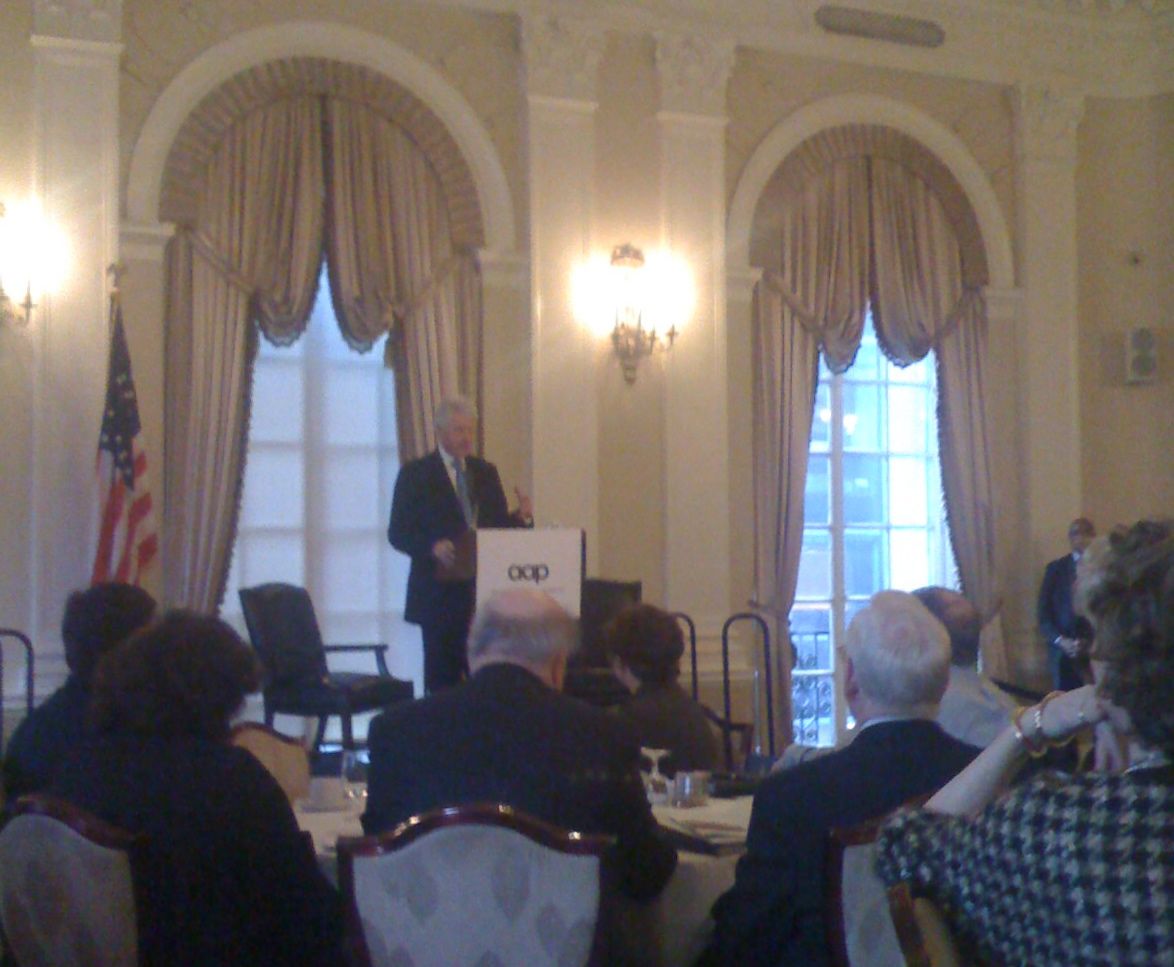
Bill Clinton, speaking to the AAP in March 2009
I don't mean to be partisan; the argument applies equally to Dreams of My Father and The Audacity of Hope; the Obama administration has so far been very friendly to the book publishing industry on its "special issues". And don't think that Bill Clinton would have been speaking at the Association of American Publishers Annual Meeting, as he did last year, if he wasn't also an author with a big deal.

It's surprising that these arrangements don't get more scrutiny. It would be illegal for a politician to accept money into a personal bank account from a big company with major political issues before him, but it's OK for a publishing company to write 7-figure checks as advances to those same politicians if there's a book being written to serve as a fig leaf.

Publishing books has always been a double-edged sword for politicians and advocacy groups; a good book bolsters a cause both financially and intellectually. The publicity tour surrounding a book is as much about publicizing the cause as it is about selling the book. But looking to the future, what sort of digital business models will be most effective for authors whose primary goal is to advance a cause?

While the current business model offers many advantages such as access to a publisher's marketing and distribution channels, the author receives a rather small percentage of the money paid by book purchasers. In 2008, the year he was elected, Barack Obama's books sold about a million copies; he reported income from these of $2.5 million. Most authors get a significantly smaller percentage of sales.

If you've been reading this blog, you probably won't be surprised at the alternative I suggest:  bounty markets for open-access ebooks will be the ideal way to accomplish the twin aims of advocacy and fundraising. By first raising money from core supporters, and then releasing an ebook for free, a cause-oriented author can use the open access ebook to gain new converts.

Perhaps ebook bounty markets will even need to put in safeguards to avoid being misused as a naked money conduit to launder campaign contributions.

A guy can dream, can't he?

Friday, December 24, 2010

Christmas and Cooking

In Lalbagh Garden, in Bangalore, I found this plaque establishing the link between Christmas (tree) and the Cook (pine):
"Christian community treat this tree as sacred one & worship during Christmas."
Note the Muslim women having a photo snapped, with "Christmas Trees" in the background.
In my house, many holiday rituals surround cooking. One of my most precious possessions is this copy of Stora Kokboken, which I haul out every December to help with my liver pâté, my award-winning Swedish coffeebread and whatever else sparks happy memories. I say hello to my mom's notations and feel her presence.
(Stora Kokboken, Edith Ekegårdh and Britta Hallman-Haggren, Wezäta Förlag, Göteborg, 1957)
Opposite the title page is this:
My parents were married in December of 1957; the cookbook was a Christmas present from my mom's father, stepmother and stepsister. The note says "En god jul önskar vi er!" which translates as "We wish you a Merry Christmas".

What they said.

Tuesday, December 21, 2010

Crossing the Street in India

It sounds funny to say, but the thing I'll remember longest about my two weeks in India is learning to cross the street. When I first arrived, I didn't dare. Not only do they drive on the wrong side of the street, but they also drive on the right side of the street, the middle of the street, and on various surfaces that would not be considered streets here in New Jersey.

The protocol for pedestrians and motorists to coexist was not apparent to me. Pedestrians seemed to cross the street with minimal regard for traffic; the cars unaccountably seemed to miss them at high speed. After a few days of watching this dance, I screwed up my courage and crossed in the wake of some elderly women in saris. By the weekend, I was crossing on my own; the key seemed to be steadiness- a sudden move could fool a three wheeled "auto" or motorcycle carrying a family of six into your path. Motorized vehicles in India always have to be on the lookout for the vegetable cart, cow, goat, dog or camel that might need to share the roadway.

I learned a lot about other things, too. Last Wednesday, I gave a lecture for the Bangalore chapter of the Society for Information Science. My talk was titled "Why Libraries Exist: Transitioning from Print to eBooks." I've been working on this talk for a while (based partly on this post); but this was the first time I've given it publicly; I'll be giving versions of the talk twice in February.

There were lots of questions and much discussion. There are so many differences between conditions in the US and in India regarding ebooks. Not only are adoption rates very different, but there are potential ebook applications in India that had never occurred to me.

For example, while e-reader adoption is negligible in India, it may well be that textbook distribution via e-readers may happen sooner in India than in the west. In India, textbooks are a government-run enterprise. Government agencies produce, print and distribute textbooks throughout the country; owing to the country's huge population, the number of textbooks printed is quite large. Getting the right textbooks to remote locations can be a real logistics challenge. If e-readers could be made cheaply enough, there would be many advantages and potential cost-savings in their use for textbook distribution. Compared to laptops and desktop computers, e-readers pose smaller demands on electrical infrastructure; the demand for mobile phones even in rural areas has already spurred the introduction of portable chargers (hand-powered and solar-powered).

Public libraries in India are under-utilized compared to their counterparts in the west. One of the people attending my talk was Dr. M. S. Sridhar; he asked some very penetrating questions about the effects of ebooks on readership. He asked the audience to raise their hands if they were a member of a public library. Only a few hands went up. He later sent me a copy of a column he had written for the Deccan Herald (61 (24) 24 January 2008, DH Education, p II.)
During last four decades, the percentage of American population having public library cards has increased almost three fold from about 25 to 72. On the contrary, in a progressive state like Karnataka, after 40 years of enacting a comprehensive Public Libraries Act and establishing 5000 libraries, we have not been able to reach more than 2% of the population. A poor market penetration of public libraries over half a century of National Library Movement!
If my thesis about the economic forces behind "why libraries exist" is really true, then book sharing mechanisms ought to arise in any free-market society. If so, then why is there so little utilization of public libraries in India? Is it the lack of a "reading habit"? Given  the stories I heard about even poor domestic workers making great sacrifices to send their children to expensive schools that teach English; I have my doubts about this. Perhaps it's due to a widespread availability of inexpensive books; I didn't see that in the bookstores I visited. My guess is that informal book sharing  mediated by family, clan, school and work relationships are filling the economic niche left by public libraries that fail to connect with their communities.

Having survived numerous street crossings and a 26-hour ocean and continent-crossing journey to get back home, I have a better appreciation of the many ways that societies will negotiate the print-to-digital book chasm.

Saturday, December 11, 2010

The Most Important e-Reader Company You've Never Heard Of

Imagine you're the head of a big print media company. Sales of your print products have been eroding steadily and you find yourself competing with internet businesses that have very different business models and cost structures. Your own website revenues have been growing steadily, but it will be many years before they match your print subscription revenue. You know in your heart that digital subscriptions will somehow be the answer, but your otherwise loyal reader base is resisting web subscription rates that would allow you to sustain your business.

What do you do?

One answer is something I've speculated about, based on cost reduction trends for tablets and ebook readers. Bundle a reader device into your subscriptions! The consumer gets a device for "free", and you've retained a premium subscriber. You could even bundle a shopping application and collect a commission on purchases of content made through your estore.

At first glance, the obstacles to a successful implementation of the bundled e-reader strategy might seem profound. Here's an incomplete list of what you'd have to do:
  1. You'd need an inexpensive device, of course. But it can't be something cheesy, because it will be carrying your brand.
  2. You'd need an operating system for your device. Lucky for you, Google seems to have a good solution with Android. But you still need people who can customize and adapt Android to make it shine.
  3. You'd need to figure out the logistics of getting your content onto the device. Maybe you've already started this process with Apps for iPad or Android.
  4. If you're serious about an estore, someone has to build that, too. It's not only an engineering project it's also a big business development task to gather businesses willing to sell their content and goods through your estore.
  5. You'll need to build a customer support operation.
  6. You'll need some big marketing power and a sales channel.
Most big media companies have only the last item in their portfolio of competencies, so you might expect this isn't going to happen anytime soon.

But you'd be wrong.

On Thursday, my rounds in Bangalore took me to Ninestars Information Technologies Ltd. Ninestars specializes in back-end infrastructure for publishing companies. They started out doing newspaper backfile digitization, and today they work with a Who's Who of the newspaper and publishing world. It's Ninestars, an Indian company,  that's actually doing much of the heavy lifting in the preservation of the entire world's history. Early on, Gopal Krishnan, the company's Chairman, made a crucial decision to steer away from the brute-force, labor intensive approach to digitization in favor of developing technology and automation so that jobs could be done faster and with fewer people. That decision has paid off as publishing has become more and more dependent on advanced technology, whether it's website and e-commerce development, content delivery, or mobile and tablet apps.

Ninestars operates under a "white-label" business model. If you go to their website, you'll be surprised at its small size and inertness. But don't judge a book by its cover- Ninestars and Gopal are major players. Playing the white-label role to the hilt, Ninestars wants the spotlight to shine on their customers, as if Ninestars didn't even exist.

Ninestars' e-reader strategy is similarly white-label. Tablets and e-readers are being developed by Ninestars' associated company DisplayTronics Reader Devices Ltd.. DisplayTronics CEO Dr. Somanath V S gave me a peek inside the DisplayTronics development laboratory. I saw a range of e-reader prototypes- both EPD and color LCD, all with touchscreens. These will be sold under brands that are already familiar to consumers.

DisplayTronics is also building a white-label "estore" that its customers will use to sell their content, whether on their branded e-readers, or through apps on other device platforms.

While I've written a fair amount here about business models for ebooks, I haven't really covered business models for e-readers. Everyone knows about Apple's hardware-oriented business model and Amazon's commerce oriented business model, but there's not been much in the way of business models that put content at the center -yet. With e-reader pricing dropping at a relentless pace, big media companies are potentially in an excellent position to remake the e-reader market in a ways that sustain their businesses. Companies that try to make money by selling devices might find it difficult to compete against free or subsidized devices bundled into media subscriptions.

We'll find out how well the bundled-e-reader business models work when they launch - in 2011.
Enhanced by Zemanta